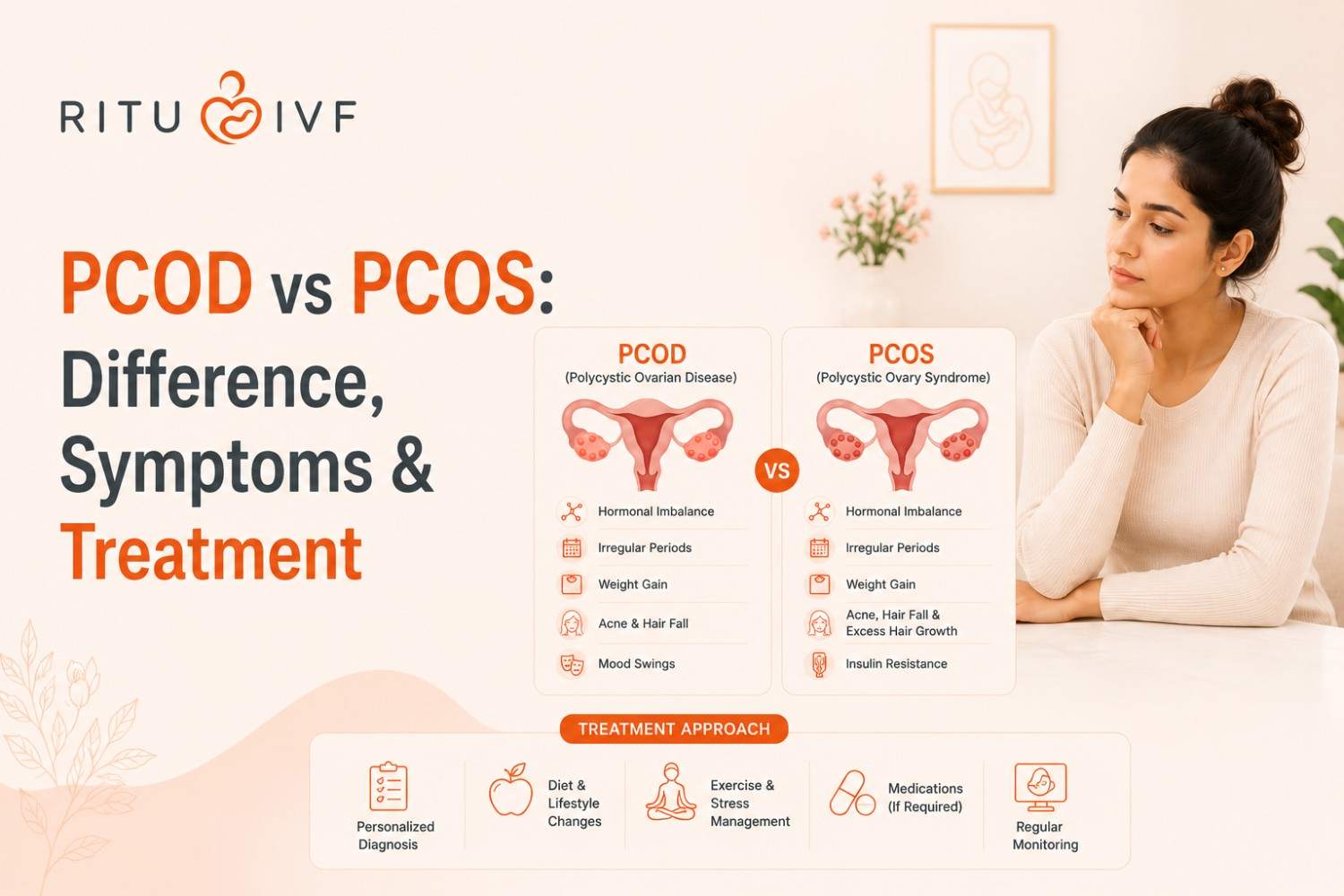
Quick Answer: PCOD (Polycystic Ovarian Disease) and PCOS (Polycystic Ovary Syndrome) are often confused, but they are not the same. PCOD is a milder ovarian condition where the ovaries release many immature eggs, and it usually responds well to lifestyle changes. PCOS is a more complex hormonal and metabolic disorder that affects the whole body and needs long-term care. PCOS is generally more serious, especially for fertility and long-term health.
Need an Appointment?
CLICK HEREAlmost every week, a woman sits across from me holding a lab report, confused and a little scared. She has been told she has “PCOD,” or maybe “PCOS,” and she is not sure what it means, how serious it is, or whether she will ever be able to have a baby.
If that sounds like you, take a breath. This is one of the most common hormonal issues we see in women today, and it is very manageable once you understand it. The problem is that the two terms, PCOD and PCOS, get mixed up constantly, even in everyday conversation.
So let me clear it all up, in plain language. What each one actually is, how they differ, what the symptoms mean, and exactly what you can do about it. I will also share the latest 2023 to 2025 medical updates, because the way doctors diagnose and treat this has genuinely changed in the last couple of years.
Key Takeaways
- PCOD is milder. The ovaries release many immature eggs, but ovulation often still happens, and fertility is usually preserved.
- PCOS is more serious. It is a hormonal and metabolic disorder that affects the whole body, not just the ovaries.
- The word “PCOD” is not really a formal medical diagnosis. Doctors worldwide diagnose PCOS, not PCOD. More on this below.
- Both are manageable. Lifestyle changes are the foundation, and most women see real improvement.
- Both allow pregnancy. Many women with PCOD or PCOS conceive, naturally or with help.
- New in 2023: A blood test called AMH can now be used instead of ultrasound to help diagnose PCOS in adults.
What is PCOD?
PCOD, or Polycystic Ovarian Disease, is a condition in which the ovaries produce many immature or partially mature eggs. Over time, these can build up as small cysts on the ovaries. The ovaries may enlarge and release slightly higher amounts of male hormones called androgens.
The good news is that PCOD is usually the milder of the two. In many women, the ovaries still work reasonably well, ovulation still happens, and periods, while sometimes irregular, are not completely absent.
Here is what defines PCOD in simple terms:
- It is mainly an ovarian issue, not a whole-body one.
- The hormonal imbalance is usually mild.
- Ovulation often still occurs, so natural pregnancy is very possible.
- It responds very well to lifestyle changes like diet, exercise, and weight management.
PCOD is extremely common. Many women have it without serious complications, and with the right habits, they manage it comfortably for years.
What is PCOS?
PCOS, or Polycystic Ovary Syndrome, is a more complex condition. It is not just an ovarian problem. It is a hormonal, metabolic, and endocrine disorder that affects the entire body.
In PCOS, the body produces higher levels of androgens, and very often there is insulin resistance, where the body’s cells stop responding well to insulin. This combination disturbs ovulation, so periods become irregular or stop, and getting pregnant becomes harder without help.
Here is what sets PCOS apart:
- It is a whole-body disorder, involving hormones and metabolism.
- Ovulation is often absent or very irregular.
- It carries long-term health risks like type 2 diabetes, heart disease, and endometrial problems.
- It usually needs long-term, structured management, not just short-term fixes.
The 2023 International Guideline on PCOS also formally recognised something many of us see in clinic every day: PCOS comes with a very high rate of psychological effects, along with risks like sleep apnea and metabolic issues. It is far more than a “period problem.”
The Honest Truth: Is “PCOD” Even a Real Medical Term?
This is something most articles will not tell you, but you deserve to know. In modern medical practice, “PCOD” is not a formal diagnosis. Doctors and international guidelines diagnose PCOS. The term “PCOD” is used casually, especially in India, often to describe a milder version of polycystic ovaries.
So why does everyone use “PCOD”? Partly habit, partly because it sounds less frightening than “syndrome.” When people say PCOD, they usually mean mild polycystic ovaries with few symptoms and preserved fertility. When they say PCOS, they mean the fuller condition with hormonal and metabolic effects.
I am explaining this not to confuse you further, but to reassure you. If one doctor said “PCOD” and another said “PCOS,” they were probably describing the same spectrum, just at different points. What actually matters is your specific symptoms, your hormone levels, and your goals, not the label.
PCOD vs PCOS: Quick Comparison Table
Here is a clear side-by-side to make the difference obvious.
| Feature | PCOD | PCOS |
|---|---|---|
| Full form | Polycystic Ovarian Disease | Polycystic Ovary Syndrome |
| What it is | Mainly an ovarian condition | A hormonal and metabolic disorder affecting the whole body |
| Medical status | Informal term, not a formal diagnosis | Recognised medical diagnosis worldwide |
| Severity | Milder, easier to manage | More complex, needs long-term care |
| Ovulation | Often still happens | Often irregular or absent |
| Hormonal imbalance | Mild | More pronounced, with high androgens |
| Insulin resistance | Uncommon | Very common |
| Fertility impact | Usually preserved | Often affected, may need treatment |
| Weight gain | Mild, if any | Common, especially around the belly |
| Long-term risks | Few, if well managed | Diabetes, heart disease, endometrial issues |
| Main treatment | Lifestyle changes | Lifestyle plus medical management |
Ready to take the next step toward parenthood
Symptoms: PCOD vs PCOS
Both conditions share many symptoms, which is exactly why they get confused. The difference is usually in how severe and how persistent the symptoms are. PCOS symptoms tend to be stronger and more stubborn.
Common PCOD symptoms
- Irregular periods, though they usually still come
- Mild acne or oily skin
- Some weight fluctuation, often manageable
- Multiple small follicles seen on an ultrasound
- Mild, occasional hair thinning
Common PCOS symptoms
- Irregular or completely missed periods, often linked to no ovulation
- Excess facial and body hair (called hirsutism), on the chin, upper lip, or chest
- Severe, persistent acne that keeps returning
- Hair thinning or hair loss on the scalp, especially the crown
- Weight gain, particularly around the abdomen, and difficulty losing it
- Darkened skin patches on the neck or underarms, a sign of insulin resistance
- Difficulty getting pregnant
If your symptoms are mild and your periods mostly show up, you are likely closer to the PCOD end. If your periods are very irregular and you have strong androgen symptoms like heavy facial hair or stubborn acne, that leans towards PCOS. Persistent irregular periods are always worth getting checked, and you can read more about the common reasons behind irregular periods.
“Which One Do I Have?” A Simple Self-Check Guide
You cannot diagnose yourself at home, and you should not try to. But this simple mental checklist can help you understand which way your body might be leaning before you see a doctor.
Ask yourself these questions:
- Do your periods usually come, even if a bit late? If yes, that leans PCOD. If they are often missing for months, that leans PCOS.
- Do you have strong androgen signs, like noticeable facial hair, deep acne, or scalp hair loss? Strong signs lean PCOS.
- Do you struggle a lot with weight, especially around the belly? This leans PCOS and possible insulin resistance.
- Has trying to conceive been difficult? Ongoing difficulty leans towards PCOS.
- Are your symptoms mild and mostly cosmetic? That leans PCOD.
Whatever your answers, the next step is the same: see a gynaecologist or fertility specialist for proper testing. This checklist is only to help you feel less lost, not to replace a real diagnosis.
Causes and Risk Factors
Both conditions come from a mix of genetics, hormones, and lifestyle. But the balance of causes is a little different for each.
What causes PCOD
- Mild hormonal imbalance affecting how eggs mature and release
- Poor diet and a sedentary lifestyle, which are major contributors
- Family history, since it often runs in families
- Chronic stress and poor sleep, which disturb hormones
What causes PCOS
- Insulin resistance, a central driver. When cells resist insulin, the body makes more of it, which pushes the ovaries to make more androgens.
- High androgen levels, which block normal ovulation and cause acne and excess hair
- Genetics, with a strong family link to PCOS, diabetes, or metabolic disease
- Excess body weight, which worsens insulin resistance, though lean women can have PCOS too
The key difference: PCOD is driven more by lifestyle, while PCOS has a deeper metabolic and hormonal root. That is why PCOS usually needs more than lifestyle changes alone.
How PCOD and PCOS Are Diagnosed
Diagnosis matters, because the right label guides the right treatment. Here is how doctors actually assess it, including what changed recently.
A proper evaluation usually includes:
- Medical history, covering your periods, weight changes, acne, and hair growth
- Physical examination, checking for signs of excess androgens and skin changes
- Blood tests, to measure hormones like testosterone, LH, FSH, and to check insulin and sugar levels
- Pelvic ultrasound, to look at the ovaries and count follicles
- Thyroid and prolactin tests, to rule out other causes of irregular periods
For PCOS specifically, doctors use the Rotterdam criteria. This means you need at least two of these three features: irregular or absent ovulation, signs of high androgens (either physical or in blood tests), and polycystic ovaries.
Here is the important 2023 update. The latest International Guideline made two practical changes for adults. First, a blood test called AMH (anti-Mullerian hormone) can now be used instead of an ultrasound to check for polycystic ovaries. Second, and very helpfully, if a woman already has both irregular periods and clear signs of high androgens, she may not need an ultrasound or AMH test at all. The diagnosis is simpler in that case. This spares many women an unnecessary scan.
For teenagers, the guideline is more cautious. Both irregular ovulation and high androgen signs are needed, and ultrasound and AMH are not recommended, because polycystic-looking ovaries are common and normal at that age.
Which Is More Serious? Long-Term Health Risks
If you take one thing from this article, let it be this: PCOS is generally more serious than PCOD, not because of the symptoms you see today, but because of the risks it carries for the future.
PCOD, when managed with a decent lifestyle, rarely causes major long-term problems. PCOS is different, because the insulin resistance and hormonal imbalance behind it affect the whole body over time.
Here are the long-term risks linked mainly to PCOS:
- Type 2 diabetes, driven by insulin resistance
- Heart disease and high blood pressure, from metabolic changes
- Obesity and metabolic syndrome, which feed back into worse hormones
- Endometrial problems, because missed periods let the uterine lining build up unchecked
- Sleep apnea, now formally recognised in the latest guideline
- Fatty liver disease, increasingly seen in PCOS
There is one more risk that older articles ignore, and I refuse to. Mental health. The 2023 International Guideline specifically highlighted the very high rate of anxiety and depression in women with PCOS. This is real, it is common, and it deserves care. More on that further down.
None of this is meant to scare you. It is meant to explain why PCOS deserves proper, ongoing attention rather than being brushed off as “just irregular periods.”
Treatment and Management of PCOD and PCOS
Here is the honest, reassuring truth: neither condition can be “cured” in the sense of disappearing forever, but both are very manageable. Most women who commit to the right plan see real, lasting improvement. Treatment is built in layers.
Layer 1: Lifestyle changes (the foundation for both)
This is where every treatment plan starts, and for many women with PCOD, it is enough on its own.
- Balanced diet: Focus on whole foods, more fibre, and fewer refined carbs and sugary items. More on diet below.
- Regular movement: Any consistent activity helps. The latest guideline is clear that no single exercise type is magically better, so pick what you will actually stick to.
- Weight management, if needed: Losing even 5 to 10 percent of body weight can restore periods and improve symptoms noticeably. That is a small, achievable target.
- Sleep and stress: Poor sleep and chronic stress worsen hormones. Yoga, meditation, and a steady sleep routine genuinely help.
One important note from the 2023 guideline: healthy habits matter for all women with PCOS, including lean women. This is not only about weight. It is about metabolic health.
Layer 2: Medical treatment
When lifestyle alone is not enough, doctors add medication based on your specific symptoms and goals.
- Combined oral contraceptive pills: These are the first-line medical treatment for irregular periods and for androgen symptoms like acne and excess hair. They regulate cycles and protect the uterine lining.
- Metformin: Recommended mainly for the metabolic side, especially insulin resistance. The latest guideline notes metformin is more effective than inositol for these features.
- Anti-androgen medicines: Used to reduce excess hair growth and stubborn acne, usually alongside contraception.
- Inositol: A popular supplement. The 2023 guideline reviewed it honestly: it may offer some metabolic and hormonal benefit with little harm, but the evidence is limited, and it is less effective than metformin. It is a “may consider,” not a “must.”
Every plan should be personalised. There is no single pill that fits everyone, and the right choice depends on whether you want to manage symptoms, protect long-term health, or conceive.
Layer 3: Fertility treatment (when planning pregnancy)
If you are trying to conceive, the approach shifts. This is where a fertility specialist comes in, and I will cover it properly in the next section.
For treatment tailored to your body, it helps to consult a team that handles this every day. You can learn about focused PCOS treatment in Jaipur to understand what a structured plan looks like.
Ready to take the next step toward parenthood
PCOD and PCOS Diet: What to Eat and Avoid
Diet is the single most powerful daily tool you have, and most articles barely explain it. So let me be specific and practical.
The core idea is simple: eat in a way that keeps your blood sugar steady. Sudden sugar spikes worsen insulin resistance, which worsens PCOS. That is the whole logic behind a good PCOS diet.
Foods to eat more of
- High-fibre vegetables: leafy greens, beans, broccoli, and most non-starchy vegetables
- Whole grains: oats, brown rice, millets like bajra and jowar, instead of refined flour
- Lean protein: eggs, dal, paneer, tofu, chicken, and fish
- Healthy fats: nuts, seeds, and olive oil
- Low-sugar fruits: berries, apple, pear, and guava
Foods to limit or avoid
- Sugary items: sweets, cold drinks, packaged juices
- Refined carbs: white bread, maida, most biscuits and bakery items
- Deep-fried and heavily processed foods
- Excess tea and coffee with sugar
A simple sample day
- Morning: vegetable oats or a besan chilla with a boiled egg
- Lunch: two millet rotis, dal, a large portion of vegetables, and curd
- Snack: a handful of nuts, or fruit with peanut butter
- Dinner: grilled paneer or chicken with sauteed vegetables and a small portion of brown rice
You do not need a perfect, punishing diet. You need a consistent, balanced one. Because diet and hormones are so closely linked, it helps to understand the wider connection between diet and fertility too.
Can You Get Pregnant With PCOD or PCOS?
Yes. This is the question that worries women the most, so let me answer it clearly and warmly: most women with PCOD or PCOS can have a baby.
With PCOD, fertility is usually preserved. Since ovulation often still happens, many women conceive naturally, especially after improving their diet, activity, and weight. The path is frequently straightforward.
With PCOS, it can take more effort, because ovulation is irregular or absent. But this is one of the most treatable causes of infertility we deal with. The usual path looks like this:
- Lifestyle and weight optimisation first, which alone restarts ovulation for many women
- Ovulation-inducing medicines, to help the ovaries release an egg
- IUI (intrauterine insemination), if needed
- IVF, for cases that need more support
The results are genuinely encouraging. PCOS responds well to treatment, and success rates are strong when care is structured. If you want to understand your odds better, we have detailed information on IVF success rates for women with PCOD and PCOS, and on practical PCOS and conception tips that can help you start in the right direction.
The key message: a PCOS diagnosis is not a closed door. For most couples, it is simply a path that needs the right guidance.
Can PCOD Turn Into PCOS? And Can You Prevent It?
This is a common fear, so let me address it honestly. Strictly speaking, PCOD and PCOS are described as separate conditions, and one does not automatically “convert” into the other like a disease progressing.
But here is the practical reality I see in clinic. Because “PCOD” usually describes a milder state, an unhealthy lifestyle over years, with weight gain and worsening insulin resistance, can push a mild picture towards a more PCOS-like one. So while it is not a formal conversion, the direction your health takes does matter.
That is actually good news, because it means you have real influence here. To keep things from worsening:
- Keep your weight in a healthy range, since this is the biggest lever
- Stay active consistently, even with simple daily movement
- Eat to keep blood sugar steady, as described above
- Get regular check-ups, so any change is caught early
- Do not ignore irregular periods for years hoping they fix themselves
Prevention is not about perfection. It is about steady, sensible habits that keep your hormones and metabolism on your side.
The Emotional Side: PCOS, Mental Health, and Body Image
I want to talk about something most medical articles skip entirely, because it matters as much as any lab value.
Living with PCOS or PCOD can be hard on your mind, not just your body. The acne, the excess hair, the weight that will not shift, the unpredictable periods, and the worry about fertility all add up. The latest 2023 guideline formally recognised that women with PCOS have a very high rate of anxiety and depression. You are not imagining it, and you are not weak for feeling it.
If this is you, please hear me: your feelings are valid, and support helps. A few things that genuinely make a difference:
- Treat the whole you, not just the symptoms. Good hormonal control often lifts mood too.
- Do not face it alone. Talk to your doctor about how you feel, not only about your periods.
- Consider professional support if anxiety or low mood is affecting daily life. That is a strength, not a failure.
- Be kind to your body. It is managing a real medical condition, and it deserves patience.
Care that ignores your emotional health is incomplete care. A good clinic treats both.
PMOS: The New Name for PCOS, Explained
Here is a genuinely fresh development that most articles have not caught up with yet.
There is a growing move in medicine to rename PCOS as PMOS, which stands for Polyendocrine Metabolic Ovarian Syndrome. Why the change? Because experts feel “polycystic ovary syndrome” is misleading. Many women with the condition do not actually have cysts, and the name focuses on the ovaries when the condition is really about hormones and metabolism across the whole body.
This is very current. In 2026, the UK’s health authority NICE issued its first guidance using the PMOS name, with a final version expected later in 2026. So this is an active, in-progress change, not a done deal.
What this means for you, practically: for now, PCOS is still the standard term used by doctors in India and most of the world. If you hear “PMOS” in the future, know that it refers to the same condition you already understand. The name may be evolving, but the condition, and the way we manage it, remains the same.
Myths vs Facts
Myth: PCOD and PCOS are the same thing. Fact: They overlap, but PCOS is a more complex whole-body disorder, while PCOD is usually milder and ovary-focused.
Myth: If you have PCOS, you cannot have children. Fact: Most women with PCOS can conceive, often with lifestyle changes or fertility treatment.
Myth: Only overweight women get PCOS. Fact: Lean women get PCOS too, and they can still have insulin resistance and metabolic risk.
Myth: PCOS means your ovaries are full of dangerous cysts. Fact: The “cysts” are actually small, immature follicles, not harmful cysts that need removal.
Myth: Losing weight will completely cure PCOS. Fact: Weight loss helps a lot, but PCOS is managed, not permanently cured, by lifestyle alone.
Myth: You should ignore missed periods if you are not trying to conceive. Fact: Long gaps between periods can affect the uterine lining and need medical attention regardless.
Doctor’s Advice from Dr. Ritu Agarwal
“The women who walk into my clinic worried about PCOD or PCOS are often carrying more fear than they need to. My message is always the same. This is one of the most common and most manageable conditions I treat. Start with small, consistent lifestyle changes, get a proper diagnosis instead of guessing from the internet, and do not wait years to act on irregular periods. And if you are worried about having a baby, please know that a PCOS diagnosis is rarely the end of that dream. With the right plan, most women get there.” — Dr. Ritu Agarwal
I will add one honest note, as I always do. No treatment works overnight, and no one can promise a guaranteed result. What a good team can promise is an accurate diagnosis, an honest plan built around your body, and steady support at every step.
When Should You See a Doctor?
Do not wait for things to get severe. See a gynaecologist or fertility specialist if you notice any of these:
- Periods that are consistently irregular, or gaps longer than a couple of months
- Strong androgen symptoms, like heavy facial hair, deep acne, or scalp hair loss
- Difficulty losing weight alongside irregular cycles
- Trouble conceiving after trying for a reasonable time
- Darkened skin patches, which can signal insulin resistance
- Feeling anxious or low because of your symptoms
Early evaluation makes everything easier. A simple set of tests can give you clarity and a plan, instead of months of worry.
Summary and Next Step
PCOD and PCOS are related but not identical. PCOD is usually milder, mostly affects the ovaries, and often responds to lifestyle changes alone. PCOS is a deeper hormonal and metabolic disorder that needs ongoing, structured care and carries more long-term risk.
The encouraging truth is that both are manageable, and both usually allow pregnancy. Diet, movement, and the right medical support can transform how you feel and protect your future health. And with the science improving every year, from the 2023 diagnostic updates to the ongoing PMOS renaming, care keeps getting better.
Whatever label you have been given, the next step is the same: get a proper assessment and a plan built for you.
Ready to take the next step toward parenthood
Frequently Asked Questions
What is the main difference between PCOD and PCOS?
PCOD is a milder, mostly ovarian condition where ovulation often still happens. PCOS is a more complex whole-body hormonal and metabolic disorder, with irregular ovulation and higher long-term health risks.
Which is more serious, PCOD or PCOS?
PCOS is generally more serious. It affects metabolism and raises the risk of diabetes, heart disease, and endometrial problems, so it needs long-term management.
Can PCOD turn into PCOS?
They are described as separate conditions, so one does not formally convert into the other. But an unhealthy lifestyle can push a mild picture towards a more PCOS-like state over time, which is why habits matter.
Can I get pregnant with PCOD or PCOS?
Yes. Most women with PCOD conceive naturally, often after lifestyle changes. Women with PCOS may need ovulation medicines, IUI, or IVF, but success rates are strong with proper care.
Can PCOD or PCOS be cured permanently?
Neither has a permanent cure, but both are highly manageable. With lifestyle changes and, where needed, medication, most women control their symptoms well.
How is PCOS diagnosed now?
Doctors use the Rotterdam criteria, needing two of three features: irregular ovulation, high androgens, and polycystic ovaries. Since 2023, an AMH blood test can replace ultrasound in adults, and if irregular periods and high androgens are both present, no scan may be needed.
What is the best diet for PCOD and PCOS?
A blood-sugar-friendly diet works best: high fibre, whole grains, lean protein, and healthy fats, while limiting sugar, refined carbs, and fried foods. No single diet is proven superior, so consistency matters most.
Is inositol good for PCOS?
It may offer some metabolic and hormonal benefit with little harm, but the evidence is limited and it is less effective than metformin. Treat it as an optional add-on, guided by your doctor.
Does PCOS affect mental health?
Yes. The latest guideline recognises a high rate of anxiety and depression in women with PCOS. Emotional support should be part of treatment, not an afterthought.
Is PCOS being renamed?
There is a move to rename PCOS as PMOS (Polyendocrine Metabolic Ovarian Syndrome), because many women do not have cysts and the condition is really about hormones and metabolism. For now, PCOS remains the standard term in India and most of the world.
How much does PCOS affect Indian women?
Studies in India vary widely, but pooled estimates suggest roughly 8 to 13 percent of women of reproductive age are affected, making it one of the most common hormonal conditions.
What tests should I ask for?
Typically a hormone panel, blood sugar and insulin checks, thyroid and prolactin tests, and a pelvic ultrasound or AMH. Your doctor will tailor these to your symptoms.
Medical Disclaimer: This article is for general information and awareness only. It is not a substitute for personal medical advice. PCOD and PCOS vary from person to person, so please consult a qualified gynaecologist or fertility specialist for diagnosis and treatment specific to you.
Leave a Reply