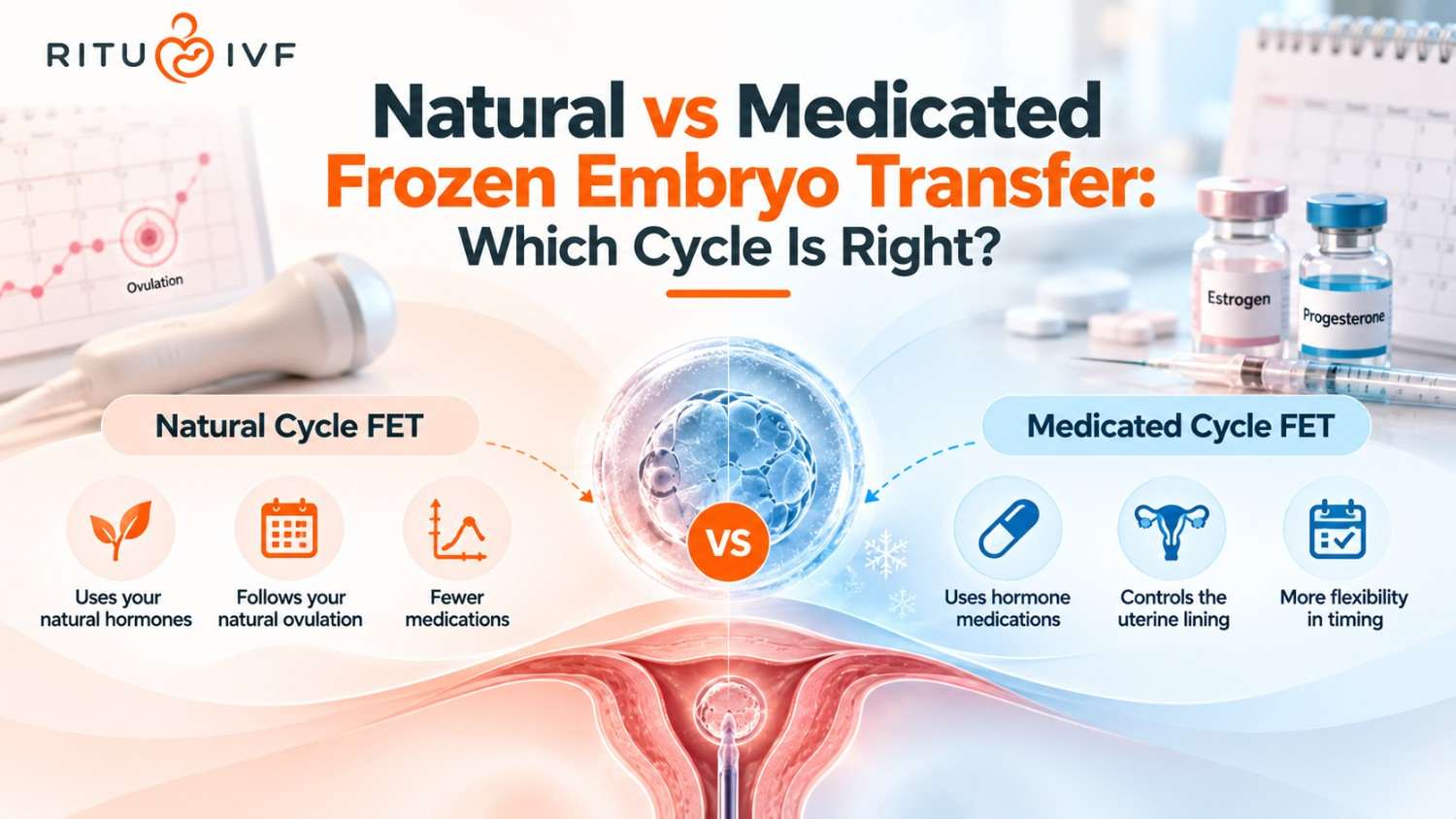
Quick Answer: In a natural frozen embryo transfer, your own cycle and ovulation decide the timing, with little or no medication. In a medicated (programmed) cycle, hormones like estrogen and progesterone prepare the lining and the clinic controls the timing. Both work well, and success rates are broadly comparable. Recent evidence suggests natural cycles may be preferred for women who ovulate regularly, while medicated cycles suit those with irregular or absent ovulation.
If your embryos are frozen and ready for transfer, your doctor may have offered you a choice: a natural cycle or a medicated one. It is a confusing decision, because both sound reasonable and you just want the one that gives you the best chance.
Here is the honest truth upfront. Neither is universally “better.” The right choice depends mostly on your own body, especially whether you ovulate regularly. In this guide I will explain both clearly, share what the latest research shows, and help you understand which cycle tends to suit whom.
Need an Appointment?
CLICK HEREWhat Is a Frozen Embryo Transfer (FET)?
A frozen embryo transfer is when an embryo created during IVF, and then frozen, is thawed and placed into the uterus in a later cycle. It has become a very common and reliable part of modern IVF.
The embryo itself is the same in both approaches. What differs is how the uterine lining is prepared to receive it. You can read the basics in our guide to frozen embryo transfer.
What Is a Natural Cycle FET?
A natural cycle FET works with your body’s own menstrual rhythm. Instead of using hormones to build the lining, your doctor tracks your natural cycle and ovulation, then times the transfer to match when your body is naturally ready.
This approach uses little or no medication. It relies on your own ovulation to produce progesterone from the corpus luteum, which is the small structure that forms after an egg is released. For this reason, a natural cycle only works if you ovulate regularly.
What Is a Medicated (Programmed) FET?
A medicated FET, also called a programmed or artificial cycle, uses hormone medication to prepare the uterus. Estrogen is given to build the lining, and progesterone is added to make it ready for the embryo.
In this approach, your natural ovulation is usually suppressed, and the clinic fully controls the timing. This makes scheduling very predictable, which is useful in many situations. The trade-off is more medication and the absence of a corpus luteum, a point we will return to.
Natural vs Medicated FET: Key Differences
Here is a clear side-by-side to make the two approaches easy to compare.
| Feature | Natural Cycle FET | Medicated (Programmed) FET |
|---|---|---|
| Medication | Little or none | Estrogen and progesterone |
| Timing control | Depends on your ovulation | Fully clinic-controlled |
| Requires ovulation | Yes | No |
| Monitoring | Tracks natural ovulation | Tracks lining on hormones |
| Corpus luteum | Present | Usually absent |
| Best suited to | Regular, ovulatory cycles | Irregular or absent cycles |
Neither column is “the winner.” Each fits a different body and situation, which is exactly why this is a personalised decision.

Ready to take the next step toward parenthood
The Safety Angle: Why the Corpus Luteum Matters
This is a detail most articles skip, but it is worth understanding. In a natural cycle, ovulation leaves behind a corpus luteum, which produces hormones that support early pregnancy, including those that help regulate blood vessels.
In a fully medicated cycle, there is usually no corpus luteum, because ovulation is suppressed. Some studies have linked the absence of a corpus luteum to a slightly higher risk of conditions like high blood pressure in pregnancy (preeclampsia). This does not mean medicated cycles are unsafe, as they are widely and successfully used. It simply adds one more reason why, when a natural cycle is suitable, it is often a sensible first choice.
Who Is Natural Cycle FET Best For?
A natural cycle tends to suit women whose bodies already do most of the work reliably. You may be a good candidate if you:
- Have regular menstrual cycles and ovulate predictably
- Prefer less medication and fewer injections
- Want an approach that works with your body’s own hormones
The main limitation is timing. Because it depends on your natural ovulation, the transfer date is less flexible and needs careful monitoring.
Need an Appointment?
CLICK HEREWho Is Medicated FET Best For?
A medicated cycle is often the better choice when natural timing is unreliable. It may suit you if you:
- Have irregular cycles or do not ovulate predictably
- Have conditions like PCOS that make ovulation hard to track
- Need a precisely scheduled transfer for practical or clinical reasons
- Have had timing difficulties in a previous natural attempt
Here, the predictability of a medicated cycle is a genuine advantage. It is not about one method being superior, but about choosing what can be timed reliably for your body.
Modified Natural Cycle: The Middle Path
There is also a third option that sits between the two. A modified natural cycle still relies on your own ovulation, but uses a small trigger injection to time it precisely, and sometimes a little progesterone support afterward.
This gives some of the benefits of a natural cycle, with a bit more timing control. For some women with regular cycles, it offers a helpful balance, and your doctor may suggest it as a middle path.
Pros and Cons at a Glance
| Natural Cycle FET | Medicated FET | |
|---|---|---|
| Pros | Less medication, works with your body, corpus luteum present | Predictable timing, works without ovulation, flexible scheduling |
| Cons | Needs regular ovulation, less flexible timing, more monitoring | More medication, no corpus luteum, possible added complication risk |
Lorem ipsum dolor sit amet, consectetur adipiscing elit. Ut elit tellus, luctus nec ullamcorper mattis, pulvinar dapibus leo.
Ready to take the next step toward parenthood
Myths vs Facts
Myth: Medicated FET lowers your chances because of all the hormones. Fact: Medicated cycles have success rates comparable to natural cycles across large groups. The hormones are there to prepare the lining, not to reduce your chances.
Myth: Natural cycle FET is only for people avoiding medication. Fact: It is a clinically valid, evidence-based option, and recent trials suggest it may be preferred for women who ovulate regularly.
Myth: One protocol guarantees a higher success rate for everyone. Fact: Success depends far more on embryo quality, age, and uterine health than on the protocol alone.
Myth: If my cycles are irregular, natural FET will still work fine. Fact: Irregular ovulation makes natural timing unreliable, which is exactly when a medicated cycle is usually the safer, more practical choice.
How Your Doctor Decides
The choice is never made from a template. Your doctor looks at whether you ovulate regularly, your cycle history, any conditions like PCOS, your previous FET attempts, and practical timing needs.
For a woman with regular cycles, a natural or modified natural cycle is often considered first. For someone with irregular ovulation, a medicated cycle usually makes more sense. The aim is always to match the protocol to your body, not the other way around.
A Note From the Clinic
I always tell my patients that the “best” protocol is simply the one that fits their body and situation. Both natural and medicated FET are proven, widely used approaches, and good outcomes happen with both every day.
What matters most is an honest assessment and a plan built around you, rather than a fixed rule applied to everyone. Outcomes vary from person to person, and your own likelihood depends on your age, diagnosis, and medical history.
Summary
Natural and medicated frozen embryo transfer differ mainly in how the uterine lining is prepared and who controls the timing. A natural cycle uses your own ovulation with little medication, while a medicated cycle uses hormones and full timing control.
Both work well and are broadly comparable. Recent evidence gently favours natural cycles for women who ovulate regularly, while medicated cycles remain the practical choice for irregular or absent ovulation. The right decision is a personalised one, best made with your specialist.
Frequently Asked Questions
Which is better, natural or medicated FET?
Neither is universally better. Success rates are broadly comparable. Recent evidence suggests natural cycles may be preferred for women who ovulate regularly, while medicated cycles suit those with irregular or absent ovulation.
Does medicated FET have a lower success rate?
No. Across large groups, medicated and natural cycles have comparable success rates. Some recent trials show a slight edge for natural cycles in ovulatory women, but the protocol is only one of many factors.
Who should choose a natural cycle FET?
Women with regular, predictable ovulation who prefer less medication are often good candidates. It depends on reliable ovulation for correct timing.
Who should choose a medicated FET?
Women with irregular cycles, PCOS, or unpredictable ovulation usually benefit from a medicated cycle, because the timing can be controlled precisely.
What is a modified natural cycle?
It is a middle option that uses your own ovulation with a small trigger injection for precise timing, and sometimes light progesterone support. It balances natural benefits with more timing control.
Is a natural cycle safer for pregnancy?
Some studies link the natural cycle’s corpus luteum to a lower risk of certain pregnancy complications, like high blood pressure. Medicated cycles are still widely used and effective, so this is one factor among many your doctor will weigh.
Can I switch protocols if one does not work?
Yes. If timing or outcomes are a problem with one approach, your doctor may adjust the plan for the next cycle. The protocol can be tailored based on how your body responds.
Medical Disclaimer: This article is for general information and awareness only. It is not a substitute for personal medical advice. Please discuss your specific situation with a qualified fertility specialist. This article was prepared with the help of research and digital/AI tools and reviewed for accuracy by Dr. Ritu Agarwal.
Leave a Reply