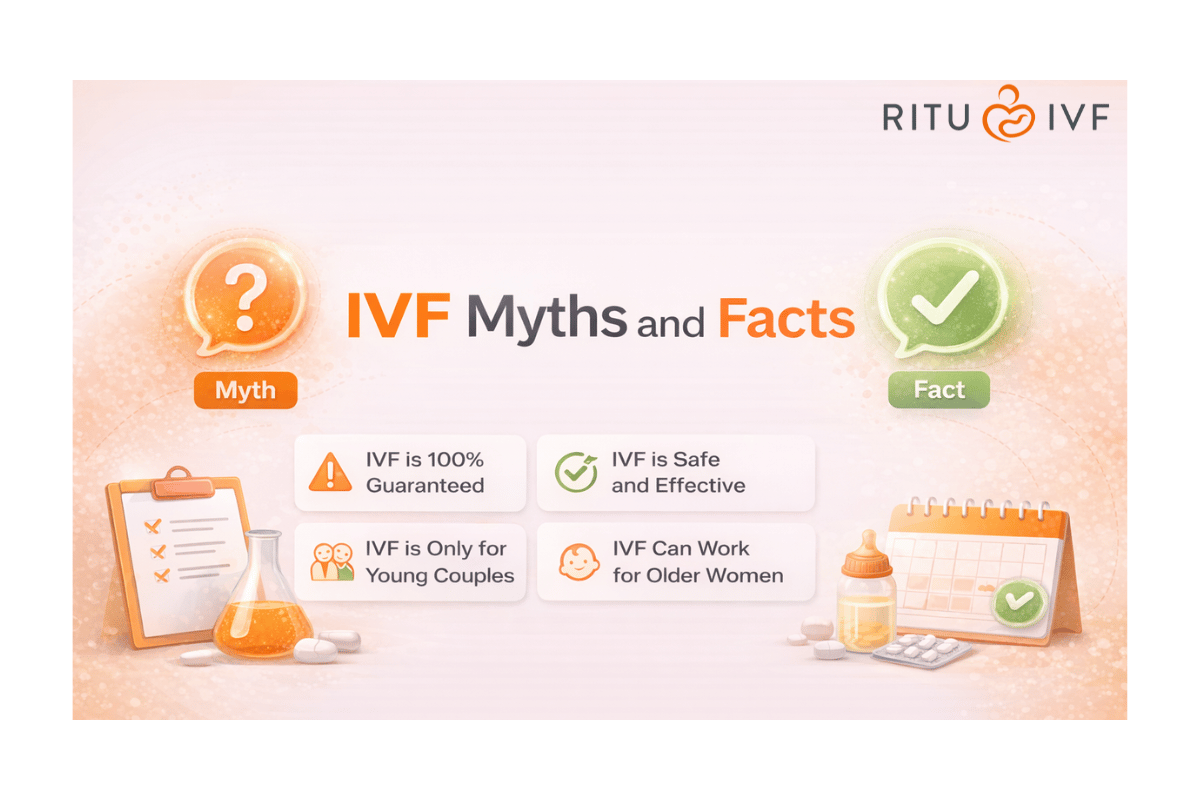
IVF myths and facts are among the most searched topics by couples considering fertility treatment today. Misinformation about IVF spreads fast, and believing the wrong things can delay your treatment and damage your chances of becoming a parent. Understanding true IVF myths and facts is therefore not just helpful, it is essential. Common misconceptions about IVF cause unnecessary fear, confusion, and hesitation in couples who genuinely need medical help. In this guide, we separate fiction from science so you can walk into your fertility journey with clarity and confidence.

Ready to take the next step toward parenthoo
[Book an Appointment Now]
Quick Overview: IVF Myths vs Facts at a Glance
| Myth | Fact |
|---|---|
| IVF always results in twins | Single embryo transfer is now standard practice |
| IVF causes cancer | No scientific evidence supports this claim |
| IVF is only for women | Male factor infertility is treated with IVF too |
| IVF is always painful | Most patients experience only mild discomfort |
| IVF guarantees pregnancy | Success depends on age, health, and diagnosis |
What Are the Biggest Common Misconceptions About IVF?
Before starting treatment, most couples encounter dozens of common misconceptions about IVF from family, friends, and unreliable online sources. These myths range from fears about cancer risk and multiple births to beliefs that IVF is only for older women or a last resort. The truth is that IVF is a well-researched, globally proven fertility treatment that has helped over 8 million babies be born worldwide. Separating IVF myths and facts early gives couples the confidence to seek help without unnecessary delay.
Myth 1: IVF Always Causes Twins or Triplets
One of the most widespread common misconceptions about IVF is that it always leads to multiple pregnancies. This was partially true in the early days of IVF when doctors transferred multiple embryos to improve success chances. Today, that practice has changed significantly.
The Truth About Multiple Births and IVF
- Modern IVF uses elective single embryo transfer (eSET) as the standard approach
- The American Society for Reproductive Medicine (ASRM) recommends single embryo transfer for most patients
- Multiple births occur only when more than one embryo is deliberately transferred
- Advanced lab techniques improve single embryo success rates significantly
- Twin pregnancies carry higher health risks for both mother and baby
The IVF myths and facts around multiple births are clear: twins are not an automatic outcome. Your doctor chooses the safest and most effective transfer strategy based on your individual case.
Myth 2: Is IVF Safe for Women? Cancer Risk Explained
A very common fear is that IVF hormonal medications increase the risk of breast or ovarian cancer. This myth has caused many women to delay or avoid treatment entirely. Understanding whether is IVF safe for women is therefore one of the most important questions to answer with evidence.
What Research Actually Says
- Multiple large-scale studies show no significant link between IVF medications and cancer
- The hormonal stimulation used in IVF works only on eggs already scheduled for that month’s cycle
- Women with infertility may have a slightly higher baseline cancer risk due to genetic factors, not IVF
- IVF medications do not deplete your future egg reserve or trigger early menopause
- All patients undergo thorough medical screening before starting any IVF protocol
Is IVF safe for women? The medical consensus is yes. IVF is one of the most studied medical procedures in the world and carries a well-documented safety record across decades of clinical use.
Myth 3: IVF Success Rate Truth, Does It Always Work?
Many couples either overestimate or underestimate IVF success. Some believe IVF always works on the first try. Others believe it never works at all. Neither extreme reflects the IVF success rate truth.
IVF Success Rate Truth by Age Group
| Age Group | Live Birth Rate Per Cycle |
|---|---|
| Under 35 | Up to 48.5% |
| 35 to 37 | Around 38.3% |
| 38 to 40 | Around 26.8% |
| 41 to 42 | Around 11 to 13% |
The IVF success rate truth is that outcomes depend on several key factors including age, egg quality, sperm quality, embryo health, uterine receptivity, and the experience of the fertility team. Success is not guaranteed in a single cycle, but cumulative success rates across multiple cycles are significantly higher. Many couples who do not succeed in the first attempt do achieve pregnancy in subsequent cycles.
Myth 4: IVF Is Only a Last Resort
Another damaging myth is that IVF should only be considered after years of failed treatments. While it is true that simpler treatments are often tried first, IVF is recommended earlier in specific situations. Waiting too long can reduce success rates, especially as a woman ages.
When IVF Is Recommended Earlier
- Both fallopian tubes are blocked or removed
- Severe male factor infertility with very low sperm count
- Failed multiple IUI cycles without success
- Advanced maternal age (over 35 years)
- Diagnosed genetic disorders requiring preimplantation genetic testing (PGT)
- Endometriosis affecting egg quality or tube function
IVF myths and facts around timing matter because age is the single biggest factor in IVF success. Your fertility specialist will always recommend the most appropriate treatment path based on your diagnosis.
Myth 5: IVF Babies Are Not as Healthy as Naturally Conceived Babies
This is one of the most emotionally charged common misconceptions about IVF. Many parents worry that IVF babies face higher risks of developmental problems or poor health. The evidence tells a very different story.
IVF Treatment Facts About Baby Health
- The vast majority of IVF babies are born healthy and develop normally
- Long-term studies following IVF children for decades show no significant developmental differences
- Any slight increase in certain risks is linked to underlying parental health factors, not the IVF procedure itself
- Preimplantation genetic testing (PGT) actually helps select the healthiest embryos, reducing miscarriage risk
- Louise Brown, the world’s first IVF baby born in 1978, is a healthy adult today
These IVF treatment facts confirm that the laboratory process of fertilisation does not harm the baby’s health or development in any meaningful way.
Ready to take the next step toward parenthoo
[Book an Appointment Now]
IVF Treatment Facts: What the Process Actually Involves
Understanding IVF treatment facts helps remove the fear that surrounds the procedure. IVF is not a single injection or a simple pill. It is a carefully managed medical process carried out over 4 to 6 weeks per cycle.
The IVF Process Step by Step
- Ovarian stimulation: Hormone injections encourage the ovaries to produce multiple mature eggs
- Egg retrieval: A minor procedure under sedation to collect the eggs, typically taking 20 to 30 minutes
- Fertilisation: Eggs and sperm are combined in a laboratory setting
- Embryo culture: Embryos are monitored for 3 to 5 days to select the strongest one
- Embryo transfer: One healthy embryo is placed into the uterus using a thin catheter
- Pregnancy test: Conducted approximately 14 days after transfer
Most patients describe the process as manageable. Mild bloating, fatigue, and emotional sensitivity are common side effects. Serious complications like ovarian hyperstimulation syndrome (OHSS) are rare and carefully monitored by your medical team.
Is IVF Safe for Women With Other Health Conditions?
Women with conditions like PCOS, endometriosis, thyroid disorders, or uterine fibroids often wonder whether IVF is safe for them specifically. In most cases, these conditions are managed as part of the IVF preparation process.
Conditions Commonly Treated Alongside IVF
- PCOS patients are monitored closely to prevent OHSS during stimulation
- Endometriosis may require laparoscopic surgery before IVF to improve outcomes
- Thyroid levels are optimised before starting any IVF cycle
- Uterine fibroids affecting the uterine cavity are treated before embryo transfer
- Women with poor ovarian reserve may use donor eggs with high success rates
Is IVF safe for women with these conditions? With proper pre-treatment evaluation and a personalized protocol, the answer is yes for the vast majority of patients.
When Should You Consider IVF?
According to WHO, infertility is defined as failure to conceive after 12 months of regular unprotected intercourse. However, certain situations call for earlier evaluation and faster action.
- Under 35 years: Seek help after 12 months of trying
- Over 35 years: Seek help after 6 months of trying
- Diagnosed with blocked tubes, low sperm count, or PCOS
- Two or more failed IUI cycles
- History of recurrent miscarriage
- Previous pelvic surgery or infection.
Ready to take the next step toward parenthoo
[Book an Appointment Now]
Frequently Asked Questions (FAQs)
Q1: What are the most important IVF myths and facts every couple should know?
The most important IVF myths and facts include understanding that IVF does not always cause twins, does not cause cancer, and does not guarantee success in one cycle. IVF is safe, widely studied, and highly effective when matched to the right diagnosis. Couples should consult a fertility specialist rather than rely on social media or word-of-mouth information.
Q2: What is the IVF success rate truth for women over 35?
The IVF success rate truth is that age significantly affects outcomes. Women aged 35 to 37 have a live birth rate of around 38.3% per cycle. Women aged 38 to 40 achieve around 26.8% per cycle. While success rates decline with age, many women over 35 and even over 40 do achieve successful pregnancies through IVF, especially with donor eggs when needed.
Q3: Is IVF safe for women who have PCOS?
Yes, is IVF safe for women with PCOS, and the answer is yes with proper medical management. Women with PCOS are at slightly higher risk of ovarian hyperstimulation syndrome (OHSS), so fertility doctors use adjusted stimulation protocols to minimise this risk. With the right monitoring, IVF is both safe and highly effective for women with PCOS.
Q4: What are the key IVF treatment facts about the egg retrieval procedure?
IVF treatment facts show that egg retrieval is a minor outpatient procedure performed under light sedation. It takes approximately 20 to 30 minutes. Most women experience mild cramping afterward and recover within 24 hours. It is not a surgical operation requiring hospitalisation, and the vast majority of patients tolerate it well with minimal discomfort.
Q5: Are common misconceptions about IVF stopping couples from getting treatment?
Yes, common misconceptions about IVF are a major reason why couples delay seeking help. Fears about cancer, multiple births, pain, and cost prevent many people from exploring a treatment that could genuinely help them. IVF myths and facts need to be openly discussed with a qualified fertility specialist who can give personalised, evidence-based guidance.
Leave a Reply