Blog

  • Egg Freezing vs Embryo Freezing: Key Differences Explained

    Egg Freezing vs Embryo Freezing: Key Differences Explained

    Do you want to know the difference between freezing eggs and embryos? How do they work, and which option is right for you? If yes, this blog is for you. Here, we are going to discuss each so you can clear all your doubts and make the right choice for your fertility preservation.

    Today, many women and couples want more control over their future family plans. Because careers, health conditions, late marriages, or personal choices can delay pregnancy. That’s why fertility preservation has become very important, and for that, there are two choices as egg freezing and embryo freezing. Both treatments are helpful. But most people are confused, and they want to know the key difference between egg freezing and embryo freezing so that they can plan their fertility in a better and stress-free way. Both procedures sound similar, and yet they work differently and are used for different needs. 

    When it comes to fertility preservation the first question that comes to mind is which one is better, freezing eggs or freezing embryos. Both are separate processes, and each one has its own pros and cons. People are confused whether eggs are fertilised before or after. It totally depends on whether you want to decide now or later who will fertilize them. 

    Before we discuss the difference between freezing eggs and embryos, let’s start by knowing egg freezing. 

    Need an Appointment?

    CLICK HERE

    What Is Egg Freezing?

    Egg freezing is a process in which a woman’s eggs are collected and frozen for future use. The medical name for this process is oocyte cryopreservation. And in this, unfertilized eggs are stored, which allows a woman to preserve her fertility without needing a partner at the time of the procedure. 

    Here is a step-by-step process that defines how egg freezing works –

    • The woman takes hormonal injections to grow multiple eggs.
    • When the eggs are ready, the doctor collects them.
    • The eggs are frozen at a very low temperature and stored safely.

    When a woman decides to get pregnant, the IVF technique is used with frozen eggs. The egg freezing procedure is beneficial when a woman wants to preserve her fertility, but at that time, she doesn’t have a partner. The difference between egg and embryo freezing starts here. Because in the egg freezing process, sperm are not required.

    What Is Embryo Freezing?

    Embryo freezing is almost the same process as egg freezing. But in this one step is an extra. When doctors collect eggs, they fertilize them with sperm to create embryos. Once an embryo is created, it is frozen and stored. This method is mainly chosen by married couples who are planning a pregnancy later. It provides higher stability because an embryo is already fertilized and ready for plantation. 

    Both methods are used for fertilisation preservation, but the purposes and planning behind each differ. In simple words, egg freezing means freezing unfertilized eggs, and embryo freezing means freezing fertilised embryos. 

    Need an Appointment?

    CLICK HERE

    Difference Between Egg Freezing and Embryo Freezing

    The main difference between egg freezing and embryo freezing is only one step. In embryo freezing, sperm are needed, but in egg freezing, no sperm are required. Apart from that, both have their own purpose. And each one is used for a different purpose. Once you couples know the basic difference between egg and embryo freezing, they can easily make the right choice. 

    For your help, we have created a table so that everyone can understand the basic difference between freezing eggs and embryos. 

    Feature

    Egg Freezing

    Embryo Freezing

    What is frozen?

    Unfertilized eggs.

    Fertilized eggs (embryos).

    Fertilization timing

    Happens after eggs are thawed and retrieved for use in the future.

    Happens before the eggs are frozen.

    Ideal for

    Single women or those who want to keep their options open regarding a future partner or sperm donor.

    Couples or individuals with a known partner or donor sperm, who are ready to take the IVF route but want to delay pregnancy.

    Flexibility

    More flexible because a sperm source is not needed at the time of freezing.

    Less flexible because it requires a sperm source upfront and locks in a co-parenting partner.

    Success rates

    Success rates depend on factors like age, and fewer eggs may survive the thawing process.

    Generally has slightly higher success rates because you know the embryos were successfully created and can be tested for viability.

    Cost

    Potentially lower upfront costs, as you only pay for egg retrieval and freezing. You will have additional costs for IVF and fertilization later.

    Higher upfront costs because you pay for IVF and fertilization upfront, even if you never use the embryos.

    Let’s understand the basic difference in detail – 

    1. Need for Sperm

    • In egg freezing, no sperm is needed.
    • Embryo freezing, sperm required to create the embryo.

    2. Flexibility

    • Egg freezing gives women more independence and future choice.
    • Embryo freezing requires both partners to agree in the future.

    3. Storage Stability

    • Embryos are generally more stable than eggs.
    • Frozen eggs need careful handling but are highly successful with modern technology.

    4. Use in IVF

    • Frozen eggs must be fertilized later.
    • Frozen embryos can be directly transferred to the uterus during IVF.

    5. Success Chances

    Embryos usually have higher success rates than frozen eggs. Because they are already fertilized. This is one major difference between freezing eggs and embryos.

    Your Journey to Motherhood Starts Here

    “With advanced fertility care and personalized support every step of the way.”

    Contact Us

    How Success Rates Differ for Egg Freezing and Embryo Freezing

    Success rate is one of the biggest concerns for couples. While both options are reliable, there is a difference in the outcome.

    There are various factors that determine the freezing eggs success rate. Here are some of them. 

    • The woman’s age at the time of freezing
    • Egg quality
    • Number of eggs collected

    Younger women who are below the age of 35 usually get better results because younger eggs are healthier.

    Embryo freezing success rate depends on:

    • Embryo quality
    • The stage of embryo growth
    • The sperm and egg quality

    Embryos generally have a slightly higher success rate than frozen eggs. Because they already show clear signs of healthy development. This is an important difference between egg and embryo freezing for couples deciding which one is suitable for them.

    Egg and Embryo Freezing: Who Should Choose What?

    Freezing eggs and freezing embryos are different, but the outcome is the same. But each one is used according to its purpose. Each person has different needs. So let’s start to know which one is better for whom. 

    Choose Egg Freezing if:

    • You are single and want to preserve fertility.
    • You want to delay motherhood for career or personal reasons.
    • You are facing medical treatments like chemotherapy.
    • You want more flexibility in choosing a partner later.

    Choose Embryo Freezing if:

    • You have a partner and want to plan future pregnancy.
    • You want higher success chances in IVF.
    • You are ready to fertilize eggs immediately.
    • You and your partner are okay with legal agreements.

    Once you know the difference between freezing eggs and embryos, it becomes very easy to choose the right option that feels right for your future plans. 

    What are the Key Benefits of Egg Freezing?
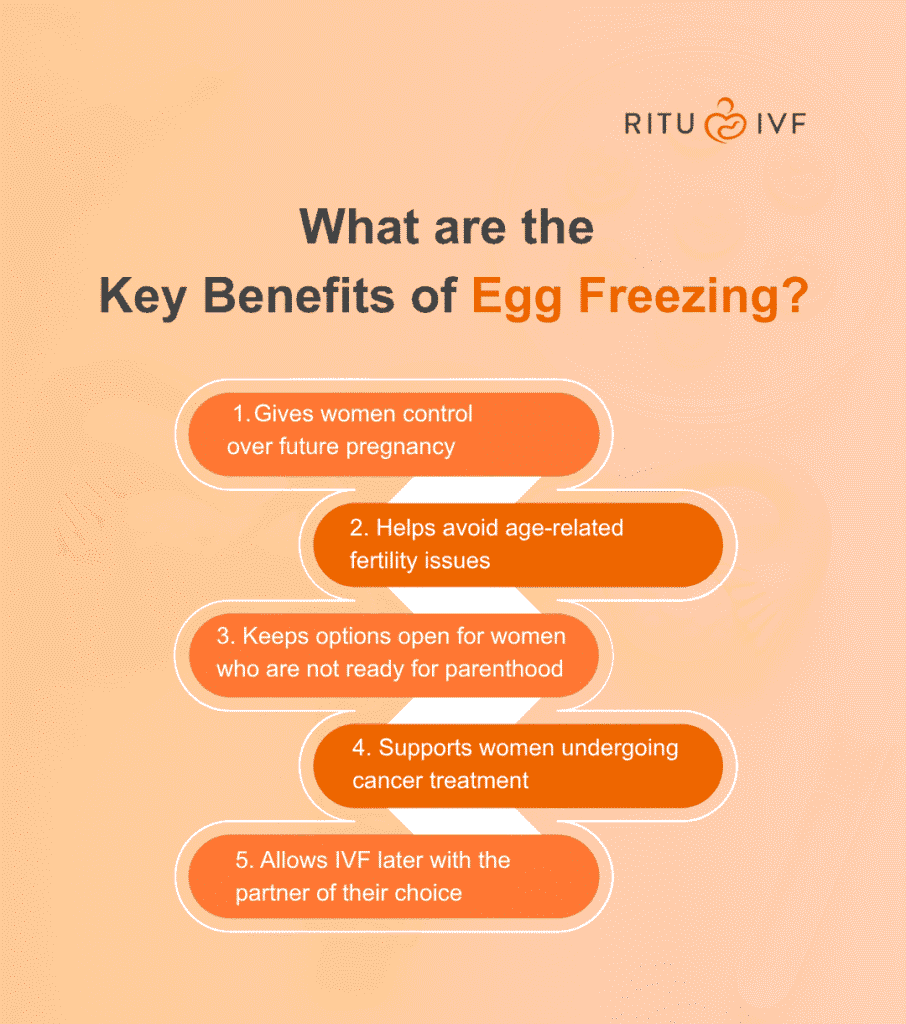
    Here is the list of the key advantages that you get when you opt for egg freezing for fertility preservation. 

    • Gives women control over future pregnancy
    • Helps avoid age-related fertility issues
    • Keeps options open for women who are not ready for parenthood
    • Supports women undergoing cancer treatment
    • Allows IVF later with the partner of their choice

    Egg freezing has become an important part of today’s egg and embryo freezing solutions because it gives women independence.

    What are the Key Benefits of Embryo Freezing?
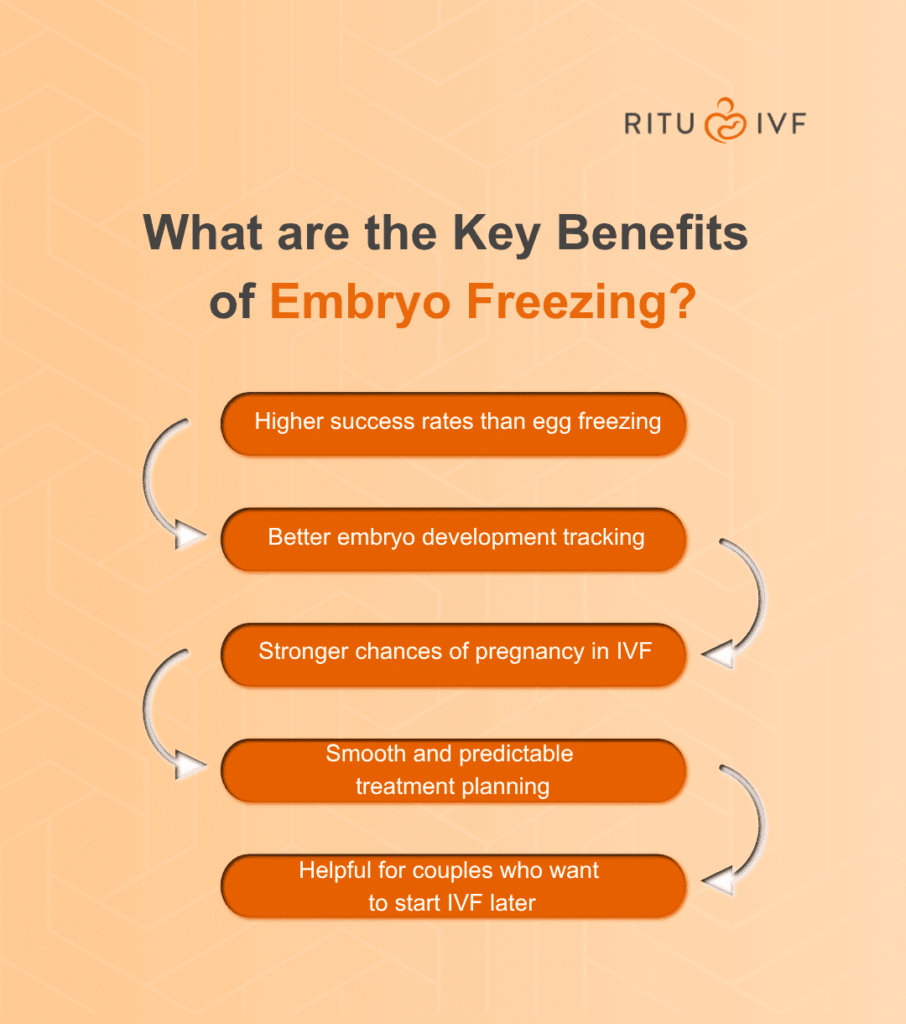
    benefits of embryo freezing

    Embryo freezing has become a popular option for couples who want more certainty. Here are the key benefits of embryo freezing. 

    • Higher success rates than egg freezing
    • Better embryo development tracking
    • Stronger chances of pregnancy in IVF
    • Smooth and predictable treatment planning
    • Helpful for couples who want to start IVF later

    Embryo freezing is often recommended by doctors when both partners are ready and agree on long-term plans.

    What is the Cost Difference Between Egg and Embryo Freezing?

    Cost is another major factor that plays a vital role in choosing a fertility preservation method. In most clinics, egg freezing costs include medication, egg retrieval, and annual storage. Meanwhile, in embryo freezing, costs include everything like egg freezing and IVF fertilization charges. That means embryo freezing is usually a little more expensive because it involves lab fertilization and embryo development monitoring. Price may vary according to age, egg count, medicine dosage, and technology used. 

    Procedure

    Includes

    Approximate Cost Range

    Additional Notes

    Egg Freezing

    Egg retrieval, freezing, and storage

    ₹1,00,000  to ₹2,50,000

    Does not include fertilization cost

    Embryo Freezing

    Egg retrieval, fertilization with sperm, embryo culture, and storage

    ₹1,50,000  to ₹3,00,000

    Slightly higher due to the lab fertilization process

    Storage Charges

    Annual maintenance of frozen eggs/embryos

    ₹15,000 to ₹30,000 per year

    Varies by clinic and duration of storage

    Why Choose Ritu IVF for Fertility Preservation

    At Ritu IVF, we understand that choosing between egg freezing and embryo freezing is a big decision. And that’s why our specialist guides you in a perfect way so that you can choose the best that fits the best for you. Here, you get experienced doctors, advanced freezing technology, safe storage, and complete emotional support that make Ritu IVF the best fertility centre in Jaipur. Whether you are planning egg freezing or embryo freezing, you can contact Ritu IVF at any time. Our experts are there for you 24X7.

    Final Words

    We hope this blog helps you to know the difference between egg freezing and embryo freezing. At first, it may be confusing, but after reading this blog, you will know which one suits you best. The right choice depends on your age, partner status, medical history, and future plans. Both options offer hope, flexibility, and a secure future for parenthood. At Ritu IVF, you can make a confident decision that supports your dreams. 

    Frequently Asked Questions (FAQs)

    Q1. What Do Doctors Recommend for the Best Results in Egg and Embryo Freezing?

    Ans. Here is the key suggestion by fertility experts. 

    • Women below 35 get the best results with egg freezing.
    • Couples ready for IVF often choose embryo freezing for better success.
    • More eggs or embryos stored, the higher the chances later.
    • A healthy lifestyle improves freezing quality.
    • Early decisions give the best future outcome.

    Doctors at Ritu IVF always guide patients based on their age, health, and family planning goals.

    Q2. Which is better, egg freezing or embryo freezing?

    Ans. Both fertility preservation methods have their benefits. Egg freezing is ideal for single women who want to preserve fertility for the future, while embryo freezing is best for couples who are ready to fertilize the eggs now and plan future pregnancies.

    Q3. How long can frozen eggs or embryos be stored?

    Ans. Both eggs and embryos can be safely stored for 10 to 15 years or even longer if kept under proper conditions in an IVF lab. The success rate depends on the woman’s age and egg quality at the time of freezing.

    Q4. Does freezing eggs or embryos affect pregnancy success?

    Ans. Not much. With modern vitrification techniques, the success rates of frozen eggs and embryos are almost similar to fresh ones. However, embryo freezing usually shows slightly higher success rates.

    Q5. Is the process of egg freezing painful?

    Ans. No, the process is generally not painful. Egg retrieval is done under light anesthesia, so you won’t feel any discomfort. Mild cramping or bloating may occur for a day or two.

  • Difference Between IVF and Normal Pregnancy: Simple Guide for Parents

    Difference Between IVF and Normal Pregnancy: Simple Guide for Parents

    Pregnancy is a beautiful journey that completes a family. But, for many couples, the path to becoming parents is not always simple. Some conceive naturally, while others need medical help like IVF. The parents who are facing any issue in conceiving naturally should not worry because in vitro fertilization is always there for them. There are a lot of myths about IVF, and one of the most common questions people generally ask is, What is the real difference between IVF and normal pregnancy?

    In an IVF pregnancy, there is a lot of confusion about symptoms, delivery options, and baby development. Some couples even worry about whether an IVF baby is different from a naturally conceived baby. But the answer is very simple, both journeys are special and both lead to the same result – a healthy child that completes your family. 

    In this blog, we are going to discuss the difference between IVF and normal pregnancy so that couples who choose IVF because of fertility issues, health conditions, or age-related challenges can clear their doubts. This blog will also help to know how IVF works and prepare you confidently for parenthood.

    Need an Appointment?

    CLICK HERE

    What Is Normal Pregnancy

    A normal or natural pregnancy happens when a sperm fertilizes an egg inside the woman’s body. And in this, the fetus develops inside a woman’s uterus over approximately 40 weeks. It usually occurs after intercourse during the fertile period. Once fertilization happens, the embryo travels to the uterus and attaches to the uterine lining. After all this, pregnancy begins. 

    But the best part of natural pregnancies is that they start without medical help. The woman’s body handles the process on its own, including fertilization, embryo formation, and implantation. So it is a totally natural process.

    What Is an IVF Pregnancy

    IVF treatment is used when a woman is unable to conceive naturally. An IVF pregnancy happens through a medical procedure called In Vitro Fertilisation. In this procedure, doctors collect eggs from the woman and fertilize them with sperm in a lab, not in the womb. Once the embryo grows, doctors place it in the uterus. If the embryo attaches successfully, the journey of an IVF pregnancy starts. 

    The main goal of IVF is to help couples who cannot conceive naturally due to problems. And problems may be many types, like blocked tubes, low sperm count, hormonal issues, or unexplained infertility. 

    Difference Between IVF and Normal Pregnancy

    When it comes to pregnancy, couples want to know the difference between IVF and normal pregnancy. The key difference is that, in a normal pregnancy, fertilisation happens inside the body, and in an IVF pregnancy, fertilization happens in a lab. But once implantation happens, both IVF and normal pregnancies happen in the same way. In both cases, the baby develops inside the womb, and the experience is quite similar. 

    Let’s understand the key difference between normal pregnancy and ivf pregnancy in simple terms. 

    • In a normal pregnancy, the couple conceives naturally.
    • In IVF pregnancy, doctors help create the embryo.
    • IVF pregnancy requires hormone support in the beginning.
    • Normal pregnancy usually starts without medication.
    • IVF pregnancy needs more monitoring during the early weeks.

    Even though the procedure is different, but result is the same. In simple words, we can say that IVF is just as natural as any other baby. So the couples who are facing issues in conceiving can opt for IVF without any doubt. Because it is also another way to complete your family. 

    Difference Between IVF Pregnancy and Normal Pregnancy Symptoms

    Now, the question is, is there any difference between IVF pregnancy and normal pregnancy symptoms, or are they quite similar? The answer is, the symptoms are almost the same. Morning sickness, breast tenderness, fatigue, mild cramping, and mood changes are the symptoms that are generally seen in both types of pregnancies. 

    But, in some cases, in the first few weeks of IVF pregnancy, symptoms may be stronger because the body receives hormone support through injections and medicines. 

    Here is the list of the common symptoms in an IVF pregnancy – 

    • Slightly stronger cramping
    • Bloating
    • Spotting in some cases due to embryo transfer
    • Breast soreness due to progesterone

    But these symptoms are not harmful and usually become normal after a few weeks. And in the end, the difference between normal pregnancy and IVF pregnancy becomes very small after the first trimester. 

    Is IVF Pregnancy Different After the First Trimester

    Both IVF pregnancy and normal delivery become almost the same after the first 12 weeks. After a certain time period, the body starts producing hormones naturally and depends less on medication. Most times, women experience regular pregnancy symptoms like nausea, increased appetite, weight gain, and emotional changes. 

    In simple words, after three months, there is no major difference between IVF and normal pregnancy unless there are no special medical issues. 

    IVF Pregnancy and Normal Delivery: Can It Happen Naturally?

    Yes, an IVF pregnancy can lead to a normal delivery. There is no doubt. Most people think that IVF always means a C-section, but this is not true. Many women are confused, and they generally ask or search for IVF pregnancy and normal delivery, so that they can know it is possible to get pregnant through IVF and have a normal delivery. 

    An IVF pregnancy can happen naturally if – 

    • The mother is healthy
    • The baby is in the correct position
    • There are no complications
    • The pregnancy is progressing normally

    Doctors suggest a C-section only if there is any risk. So the conclusion is that IVF pregnancy and normal delivery totally depend on health conditions, not on the IVF process itself. 

    Tips for IVF and Normal Pregnancy

    When a woman is pregnant, proper care is important. Here are a few simple health tips that you should not neglect. 

    • Focus on nutritious food
    • Take prescribed supplements
    • Get regular checkups
    • Avoid stress and sleep well
    • Do light exercise as advised
    • Avoid smoking and alcohol

    Emotional Difference Between IVF and Normal Pregnancy

    When a couple opt for IVF pregnancy, then they feel more pressure. Because they have to go through treatments, injections, and waiting periods, and all that makes this journey more sensitive. In the whole process, there is always a fear of failure even after proper care. 

    In a normal pregnancy, couples feel more relaxed because they don’t need to go through medical procedures. But, in both, couples need emotional support. In the starting phase, there may be a difference between IVF pregnancy and normal pregnancy in early weeks. But later, both are the same. 

    Why Choose Ritu IVF for Your IVF Journey

    Ritu IVF is known as one of the Best IVF treatment centres in Jaipur that has helped hundreds of couples to complete their family. They have the best team of doctors who have rich experience in their respective fields, which makes them one step ahead of others. The team focuses on understanding your medical history, guiding you through the IVF process, and helping you during pregnancy. At Ritu IVF, couples receive care, support, advanced fertility treatment, and emotional and medical support. There is also a consultation team that clears all your doubts, like what the difference is between IVF and normal pregnancy, before starting the IVF journey. For all kinds of IVF treatments, you can contact Ritu IVF anytime. 

    Final Words

    We hope this blog helps you to know the difference between IVF and normal pregnancy. It helps couples feel more prepared and confident. Both IVF pregnancy and normal delivery journeys start differently. But once pregnancy begins, the baby grows the same way. So there is no difference because the end result is a healthy baby. In both processes, the things that matter a lot are good care, a positive lifestyle, and the right medical support.

    If you are planning to opt for IVF, feel free to contact Ritu IVF for all kinds of guidance, support, and complete IVF facilities. Your parenthood journey deserves the best care, and Ritu IVF understands this, that’s why they are offering the best IVF services in Jaipur. 

    Frequently Asked Questions (FAQs)

    Q.1 When Should You Call Your Doctor During IVF Pregnancy or a Normal Pregnancy?

    Ans. It is important to talk to your doctor whenever anything feels unusual or uncomfortable, whether it is an IVF pregnancy or a normal pregnancy. Because some symptoms may be an early sign that your body needs medical attention. 

    Here are the key symptoms that you should not ignore and contact immediately to your doctor. 

    • Heavy or continuous bleeding
    • Strong abdominal cramps or sharp pain
    • Sudden swelling in your feet, hands, or face
    • Fever or chills
    • Less baby movement in the later months

    Q2. Is IVF pregnancy more risky than normal pregnancy?

    Ans. IVF pregnancy is generally safe, and most IVF babies are born healthy. Once the trimester is complete, the risk level becomes almost the same as a normal pregnancy. In this, extra checkups are done only to ensure whether everything is ok or not. With proper care, a healthy lifestyle, and a reputed IVF fertility center like Ritu IVF, IVF pregnancy is considered safe. 

    Q3. Do IVF pregnancy symptoms feel different from normal pregnancy symptoms?

    Ans. Yes, in the first few weeks, IVF pregnancy symptoms are generally stronger than normal delivery. All that happens due to hormone medicines. But, after a few weeks, IVF pregnancy symptoms and normal pregnancy symptoms become almost the same. Nausea, fatigue, and mood changes are the common symptoms of both types of pregnancies.

    Q4. Are IVF babies different from naturally conceived babies?

    Ans. No, IVF babies are the same as naturally conceived babies.  Their growth, intelligence, health, and development are the same as any other child. IVF is a different way but both follow the same process.

  • Best Fertility Assessment Test Online in Jaipur

    Best Fertility Assessment Test Online in Jaipur

    When planning a family, determining your fertility health is an essential step for every couple. With the ideal fertility assessment test online in Jaipur, you can take charge of your reproductive well-being from the comfort of your home. This test assists men and women in identifying fertility indicators like egg reserve, hormone levels and sperm health, which allows couples to gain a clear picture of fertility potential before looking for advanced treatment or making critical decisions. 

    Moreover, the online fertility assessment test in Jaipur includes a blend of advanced technology with expert medical analysis to deliver personalized and accurate insights. Whether you are facing challenges in conception, planning for the future or want to make sure everything is functionally adequate, these tests provide a quick and affordable way to begin your journey towards parenthood with confidence. 

    Need an Appointment?

    CLICK HERE

    Why Couples Must Look For a Fertility Assessment Test in Jaipur?

    If you are a couple planning to begin a family but currently facing challenges in conceiving, then consider opting for a fertility assessment test online in Jaipur. This test helps in identifying the root cause of infertility in males and females, such as hormonal imbalances, ovulation issues, lower sperm count, and underlying reproductive health conditions. By getting a detailed fertility evaluation early, couples can save time and receive treatment rather than rely on a delayed intervention. 

    Fertility assessment test in Jaipur is renowned for advanced medical facilities and fertility specialists, providing a range of reliable fertility evaluation options. From basic hormonal tests and semen analysis to advanced imaging and genetic screening, couples can benefit from extensive diagnostic services under expert guidance. Early evaluation increases the chances of a successful conception and helps detect health concerns that may affect future pregnancy outcomes. 

    A fertility test online is a convenient way for couples or individuals to evaluate their reproductive health from home. With sample collection and detailed digital reports, online fertility tests eliminate the requirement for frequent clinic visits. By determining your fertility profile via an online test, you can take up proactive steps towards planning a pregnancy or seek medical advice. These tests provide couples with accurate data and early awareness, enabling them to make informed decisions about their reproductive journey. 

    Selecting an online fertility assessment test in Jaipur typically empowers couples with clarity and personalized plan for their parenthood journey. With timely medical insights and professional support, couples can explore adequate fertility treatments like IUI, IVF or lifestyle modifications to enhance their reproductive health and move closer to becoming parents. 

    When Should You Look For a Fertility Test for Men and Women?

    If you have been trying to conceive a baby for at least a year naturally and cannot see a positive outcome, then looking for assistance from a healthcare provider is essential. Consider taking a female fertility test if you face any of the following issues:

    • When you are 35 years old or less and have not conceived after 1 year. 
    • When you have a history of pelvic inflammation. 
    • When you are above 35 and have not conceived after 6 months. 
    • When you had multiple miscarriage cases previously. 
    • When you underwent cancer treatment, such as chemotherapy. 
    • When you have an irregular menstrual cycle (more than 35 days). 

    If the male partner observes early signs of infertility, then it is recommended to contact a fertility expert to identify potential conditions like:

    • Low sperm count or other issues.
    • Hernia surgery.
    • History of testicular, prostate or sexual condition.
    • Smaller testicles than the average adult size. 

    Critical Fertility Tests to Look Out for Men

    critical fertility tests online in jaipur

    If you have been struggling to conceive a baby, the male partner needs to undergo a few tests, including:

    • Semen Evaluation: It is one of the standard male fertility tests, it looks for the number and quality of the sperm.
    • Fertility Blood Test: If any issues are detected in the semen analysis, the fertility health check provider looks for specific hormone levels in the blood, including testosterone, luteinizing hormone, thyroid-stimulating hormone, estradiol, prolactin, and follicle-stimulating hormone (FSH).
    • Testicular Ultrasound: If you are facing issues with semen analysis, this test will help you get a detailed picture of the scrotum and testicles to identify potential infertility causes.
    • Genetic Testing: You can check your fertility online via this test to determine if any gene changes may affect your fertility.
    • Post-ejaculatory Urinanalysis: A Fertility expert may recommend this test to check whether you have sperm in your urine. This condition is commonly termed retrograde ejaculation, which may influence fertility. 

    Essential Women Online Fertility Assessment Test in Jaipur to Keep in Check

    If you have been attempting to conceive a baby naturally for a long time, then you must look for a fertility self-assessment or a few tests under an expert’s guidance, such as:

    • Fertility Blood Test: Specific hormonal imbalances can interfere with egg production and maturation. This test typically checks hormone levels in your blood at a certain point during the menstrual cycle. However, a fertility specialist looks for progesterone, thyroid-stimulating hormone (TSH), estradiol and prolactin.
    • Genetic Testing: This test identifies mutations in your genes that can impact fertility.
    • Pelvic Ultrasound: Commonly termed as a sonogram, this test typically generates a detailed picture of your reproductive system. A fertility expert usually leverages this test to check if you have a uterine fibroid, ovarian cyst or other abnormalities.
    • Ovarian Reserve Testing: It is commonly known as the anti-Müllerian hormone (AMH) test, which combines a fertility blood test with a transvaginal ultrasound. This measures antral follicle count (AFC) and AMH hormone produced by the ovaries, which indicates whether you have an egg count compared to other women of your age. This test is essential for women undergoing IVF.
    • Sonohysterogram: This test is another type of imaging test. It assists experts in checking inside the uterus and supports understanding the cause of the infertility.
    • Hysteroscopy: In this test, a fertility professional inserts a hysteroscope (a thin and light tube) into your uterus. This enables them to examine the cervix and the inside of your uterus.
    • Hysterosalpingogram: This test utilizes fluoroscopy to take a picture of your uterus and fallopian tubes. It helps experts to understand if fertility issues are due to blockage in the fallopian tubes. 

    How Does a Fertility Test Work?

    It depends on which type of fertility test to take. A few tests include a blood draw, and a few involve imaging. However, a typical combination of both is utilized. In some cases, a healthcare provider can identify the root cause of your infertility with one test. 

    What is right for you depends on varied factors like sex, your health and sexual history. A fertility expert will provide you with insights about tests they recommend, how they work and how you can prepare and what treatments are available for your condition. 

    Your Journey to Motherhood Starts Here

    “With advanced fertility care and personalized support every step of the way.”

    Contact Us

    Final Takeaway

    Selecting a fertility assessment test online in Jaipur provides couples with a convenient, reliable and confidential way to determine their reproductive health. With advanced technology and expert medical guidance, it allows the timely detection of potential fertility issues, which assists couples in taking informed steps towards planning parenthood. Trust Ritu IVF fertility assessment to identify the root cause of infertility and get personalized treatment options. 

    FAQs

    1. What is an online fertility assessment test?

    It is a fertility quiz for couples that assists them in assessing their reproductive health and detecting potential fertility problems. 

    2. How long does the test take?

    Most fertility tests online take around 5 to 10 minutes to complete. 

    3. How accurate are online fertility tests?

    Online tests offer adequate insights; however, clinical evaluation is necessary to undergo medical tests and access accurate treatment. 

    4. Are online test data kept confidential?

    Yes, all information shared during the online fertility evaluation test remains 100% confidential. 

  • Different Types of IVF Treatments in India – A Complete Guide

    Different Types of IVF Treatments in India – A Complete Guide

    In vitro fertilization (IVF) has emerged as a pillar of assisted reproductive technology and a welcome solution to childless couples and individuals facing infertility. With the increasing number of trained and experienced fertility specialists and improved medical environments, India has quickly become a favoured travel destination for IVF treatment. From the least effective to the most advanced treatment options, and sundry types of IVF treatment, couples have an array of treatment options to improve their chances of conception and reduce dangers.

    Identifying the different types of IVF treatments in India is vital to making knowledgeable choices! Both donor eggs, the minimal stimulation protocol or gonadotropins are designed to address a specific fertility concern or lifestyle concern. India, with various degrees of success in terms of cost and processes involved, offers a wealth of IVF options, experienced embryologists, and patient-centred, advanced laboratory care. In this blog, we will summarise the types of IVF treatment to assist patients in navigating the options presented and determining which treatment best matches their challenges/situation.

    Understanding Types of IVF Treatments in India

    understanding types of ivf treatments in india

    1. Conventional IVF

    Conventional IVF is one of the standard types of IVF treatment. It includes stimulating the ovaries, leveraging fertility medications to produce multiple mature eggs. Once eggs are retrieved from the ovaries, they are further placed in a laboratory dish with thousands of motile sperm. Fertilization occurs naturally within controlled environments, and resulting embryos are tracked for development before being transferred into the uterus.

    Using this process, embryologists can select the best embryos for the couple to implant, consequently increasing the likelihood of achieving pregnancy. Conventional IVF is appropriate for patients with unexplained infertility as well as male factor infertility (mild-diagnosed male factors). This is traditionally used in embryo selection, but it also allows for other methods like Preimplantation Genetic Testing (PGT).

    Best For: Couples having endometriosis, male factor infertility or unexplained infertility.

    Success Rate: 40% to 55% per cycle (depends on age and egg quality). 

    2. Natural Cycle IVF

    Natural Cycle IVF does not initiate the utilization of fertility drugs to stimulate the ovaries. It instead partners with a woman’s natural menstrual cycle to achieve egg retrieval, focusing on one egg that matures naturally. The egg is retrieved, fertilized with the sperm in the laboratory, and a quality embryo is transferred back to the uterus. Taking this approach questions the hormonal stimulation and risk of ovarian hyperstimulation syndrome (OHSS).

    While kinder on the body and less invasive with fewer embryos produced, Natural Cycle IVF is recommended for women who wish to take a natural approach or who do not respond well to fertility medications; however, success rates are lower due to fewer available embryos.

    Best For: Women who cannot tolerate fertility drugs or a medication-free approach.

    Success Rate: 10% to 20%.

    3. IVF with Intracytoplasmic Sperm Injection (ICSI)

    ICSI is a specialized types of In Vitro Fertilization developed to address male infertility.

    In this procedure, instead of mixing many sperm with the egg, a single healthy sperm is directly injected into the cytoplasm of the egg, leveraging a microneedle. This approach makes sure fertilization even when sperm count, morphology or motility is poor.

    After fertilization, the embryo develops as standard IVF and is later transferred to the uterus. ICSI has transformed male fertility treatment by allowing conception in cases that were previously impossible. It is further used when previous IVF cycles have shown poor fertilization results or when frozen sperm or eggs are used.

    Best For: Couples who are experiencing male infertility (poor motility, abnormal morphology, or low sperm count).

    Success Rate: 50% to 70% fertilization rate per egg injected, overall pregnancy rate of 40% to 50% per cycle.

    4. IVF with Donor Eggs

    IVF with donor eggs is one of the effective IVF treatment types for women who cannot produce viable eggs due to age, genetic disorders or premature ovarian failure. In this procedure, eggs are retrieved from a healthy donor (usually under 30), fertilized with the intended father’s or donor sperm and embryos are then transferred to the recipient’s uterus.

    This technique provides a high success rate since donor eggs come from young and fertile women. It allows women to achieve the experience of pregnancy and delivery even when their eggs are considered non-viable. Emotional and legal counselling is part of the process to ensure comfort and clarity for all parties involved.

    Best For: Women with poor ovarian reserve, genetic conditions or advanced maternal age.

    Success Rate: 60% to 70% per cycle. 

    5. IVF with Donor Sperm

    IVF with donor sperm is recommended for couples dealing with severe male infertility, same-sex female couples or single women. During this procedure, donor sperm (from a sperm bank or a known donor) is leveraged to fertilize a woman’s eggs in the laboratory.

    The sperm donated for embryo creation is tested for infectious and genetic diseases to ensure safety and healthy embryo development.  This recommendation is for a situation when natural conception cannot occur because the male partner either does not have healthy sperm, is not available for this treatment or has an injurious gene.

    Ideal for: single women, couples with male fertility issues, or same sex female couples.

    Success Rate: 50% to 65% per cycle, varying based on age and quality of the eggs.

    6. Mini IVF (Mild Stimulation IVF)

    Mini IVF, also termed as mild stimulation IVF, is a reliable types of IVF treatment that uses a lower dose of fertility drugs compared to conventional IVF. The aim is to produce fewer high-quality eggs while alleviating discomfort and cost. Like traditional IVF, the similar steps are egg retrieval, fertilization, and embryo transfer, but with limited stimulation.

    Mini IVF is an affordable option for women. It also provides low stimulation and a lower risk of ovarian hyperstimulation and side effects. It is especially appropriate for women with low ovarian reserve or for women who are looking for IVF that is less invasive and more natural. 

    Great For: Women with low ovarian reserve and perhaps those looking for a more affordable, low-medication IVF option.

    Success Rate:30% to 45% per cycle

    7. Donor Embryo IVF

    Among different types of IVF options, donor embryo IVF includes sperm and egg from donors. The embryo is created in a lab and then transferred to the recipient’s uterus. This may be considered if both partners have infertility-related issues (like poor egg quality and poor sperm).

    It includes the same process of the IVF procedure, only the sperm/egg is collected from the donor and then combined in the lab to create a quality embryo.

    Best For: Couples where male and female gametes are non-functional or carry a genetic risk that they do not want to pass on further.

    Success Rate: The success rate is also high with donor egg/sperm IVF, depending on embryo quality, since donor healthy gametes are used.

    Your Journey to Motherhood Starts Here

    “With advanced fertility care and personalized support every step of the way.”

    Contact Us

    Conclusion

    In India, specialists and clinics provide varied types of IVF treatment customized to dynamic fertility challenges. Ranging from traditional IVF to cutting-edge techniques like donor-assisted IVF, ICSI and frozen embryo transfers.

    With personalized care, up-to-date technology, and expert providers, couples will have a higher likelihood of having a positive pregnancy outcome while selecting the method that best fits their medical, financial and lifestyle requirements. If you would like to know which type of IVF is best for achieving success for your condition, reach out to the Ritu IVF experts today!

    FAQs

    Q1. How successful is IVF in India?

    Ans. Success rates vary by age, health, and procedure type, with a 30% to 50% success rate per cycle for women under 35.

    Q2. Can same-sex couples opt for IVF in India?

    Ans. Yes, with donor eggs or sperm, same-sex couples can undergo IVF, along with legal requirements.

    Q3. How long is an IVF cycle?

    Ans. A standard IVF cycle (from stimulation of the ovaries to transfer) lasts 4-6 weeks. 

    Q4. How many embryos are transferred on average?

    Ans. 1-2 embryos are transferred, usually for all types of IVF treatment, to reduce the risk of multiple pregnancies.

  • How Long Can Sperm Live Inside the Female Body?

    How Long Can Sperm Live Inside the Female Body?

    While discussing conception or fertility, one of the most common questions often faced is how long does sperm live in the body? Understanding the life of sperm is important for anyone trying to get pregnant or trying to prevent it naturally. Once sperm enters the female reproductive tract, several factors, such as cervical mucus, ovulation time, and overall reproductive health, determine how long it can survive and continue to fertilise an egg.

    Moreover, sperm can live inside the female body for up to five days under optimal conditions. However, outside the fertile window or in an acidic vaginal environment, sperm’s lifespan is short. Being aware of how long can sperm live inside you can help individuals to plan intercourse timing for conception or practice safer methods for preventing pregnancy, which is an essential factor of reproductive health awareness.

    Your Journey to Motherhood Starts Here

    With advanced fertility care and personalized support every step of the way.

    Contact Us

    Understanding the Lifespan of Sperm 

    Throat Cancer Treatment Options

    The lifespan of sperm is relevant to anyone interested in conception, fertility, or reproductive health! These tiny microscopic soldiers are significant players in human reproduction, and their lifespan can depend on many factors, including temperature, environment, and exposure to other fluids in the body.

    Sperm can live only a few minutes outside of a body, but can survive for many days inside of a female’s reproductive tract–if conditions are right. Knowing how long can sperm live inside you should help when determining fertility windows and reproductive planning.

    1. Sperm Lifespan in Different Conditions

    The lifespan of sperm differs based on the environment in which it is. Inside the male body, sperm can live for several weeks inside the testes and epididymis, awaiting ejaculation. When sperm are ejaculated – and come outside the body, such as on dry surfaces or in open air – sperm tend to die relatively quickly (usually in a matter of minutes) from dehydration and temperature changes.

    In contrast to that time period, if you are wondering how long can sperm live in uterus, it is considerably longer. The cervical mucus around the time of ovulation offers a safe space for sperm to survive for up to 5 days, which is longer than it will take for sperm to swim to the egg and fertilize it! The length of time sperm can live in the uterus may be affected by cervical mucus consistency, pH levels and health.

    2. Sperm Lifespan When Frozen

    Sperm can be frozen in a process called cryopreservation for many years without loss of viability. Sperms are combined with a specific cryoprotectant solution during this process to inhibit the formation of ice crystals that could damage cells. They are then preserved for extended periods at low temperatures in liquid nitrogen, approximately -196°C (-321°F).

    In this frozen state, sperm can be preserved for as long as needed. When thawed accurately, frozen sperm can still fertilize an egg, which makes cryopreservation an ideal option for men undergoing medical treatments like chemotherapy or those planning future conception.

    Read Also – 10 Indian Foods to Avoid During Pregnancy

    How Long Does Sperm Live Inside a Woman?

    Once sperm have entered the female body, their lifespan depends on the environment, with most surviving in the female tract for up to 5 days, and likely much less, less than 3 days. To determine how long does sperm live in the body, consider sperm quality, the time of ovulation, and the condition of cervical mucus, which may either help or impede sperm.

    The female reproductive system is crucial in determining how long can sperm live inside the female body.  Cervical mucus becomes thin and alkaline near ovulation, which will provide an environment that allows sperm to swim through the cervix and into the fallopian tubes, where fertilization may occur. Whereas, outside of the fertile window, mucus is usually thicker and more acidic, which shortens sperm lifespan to a few hours.

    Moreover, it is worth noting that sperm’s journey is challenging, as millions of sperm are released during ejaculation, but only a few hundred manage to reach the egg. Sperms that survive are nourished and protected by the cervical mucus and fluids within the reproductive tract, which gives the best chance to fertilize the egg.

    Key Factors That Can Affect the Survival of Sperm

    survival of sperm infographic

    1. Semen quality and composition

    To determine how long does sperm live in the body, it is helpful to note that the semen’s health and composition can play a direct role in sperm survival. The semen is made up of enzymes, nutrients and protective proteins that help keep sperm alive while they are in transport to the eggs.

    For example, a lower volume of semen, different-shaped sperm, or poor sperm motility all contribute to a loss of opportunity for sperm to survive long enough to fertilize an egg. Lifestyle factors such as hydration, diet, and health significantly impact sperm quality.

    2. Presence of infections or toxins

    Infections in the reproductive tract and the presence of toxins indirectly ultimately reduce the sperm life span. Bacterial infections, smoking, STIs, environmental toxins, and alcohol all decrease sperm DNA integrity, decrease mobility and kill sperm.

    It is essential to protect reproductive health through proper hygiene, safe behaviour, and avoiding toxic substances to ensure sperm can survive.

    3. pH levels

    Environmental pH affects sperm survival. Sperm survive better in a slightly alkaline environment. Still, a strong acid environment, such as areas within the female reproductive tract or during infection, can be detrimental to sperm life and motility. A vaginal pH balance will support sperm viability and increase the ability to conceive.

    Read Also – What is the Cost of IVF in India? (2025 Guide)

    Determining Sperm Survival and Pregnancy Chances

    Sperm survival plays an essential role in understanding your pregnancy chances, and determining its lifespan can assist couples and individuals trying to conceive. Women with fertile cervical mucus, sperm have a higher chance of sperm reaching and fertilizing an egg. Knowing how long can sperm survive in the female reproductive tract assists in planning intercourse around ovulation to maximize conception probability. Various factors, such as lifestyle, sperm health, and the woman’s body, will affect the effectiveness of sperm.

    Once the sperm is in the female reproductive system, sperm longevity can impact conception. Generally, sperm die within hours of ejaculation, but a small percentage can survive long enough to fertilize the egg, so timing is everything. For couples planning a pregnancy, knowing how long sperm can live inside you to get pregnant is important because sperm can fertilize an egg when intercourse occurs a few days before ovulation.

    Conclusion

    Knowing how long does sperm live in the body can help couples achieve a successful pregnancy. Under optimal circumstances, sperm can survive for a maximum of 5 days in the female body, depending on the quality of the cervical mucus and overall health.

    This understanding may help couples plan intercourse better with respect to ovulation, as they make love. If you are trying to conceive or need expert fertility guidance, Ritu IVF experts can assist with personalized treatments and advanced reproductive care.

    FAQs

    1. What helps sperm survive longer in the female body?

    Fertile cervical mucus provides the necessary sustainability and protection for more prolonged survival.

    2. In what places inside the female body does sperm live?

    Sperm survive in cervical mucus and the fallopian tubes while waiting for an egg.

    3. How long does sperm live in vagina after ejaculation?

    After being released from the male body, sperm may last in the female reproductive tract for 3 to 5 days, depending on different conditions.

    4. Does sperm live if it does not reach the cervix?

    Sperms that do not reach the cervix typically die off in the vaginal environment, usually within a few hours, because it is acidic.

  • 10 Indian Foods to Avoid During Pregnancy

    10 Indian Foods to Avoid During Pregnancy

    Pregnancy is an amazing, yet sensitive, journey that every woman will experience in her lifetime, and nutrition is very important in this time. Indian food culture has much variety in both flavors and nutrients, however not all preparations are safe when pregnant. Some spices, ingredients, or the way food is prepared may put a woman at risk of infection, digestive complications. Knowing what foods to avoid during pregnancy helps mothers consciously eat through the pregnancy journey.

    From street foods to traditional Indian sweets, some culturally consumed Indian foods are most likely to be dangerous due to their high spice content, excess oil, preservatives and/or raw foods. Being mindful of foods to avoid during pregnancy India can prevent pregnancy problems such as nausea, acidity or foodborne illness and support complete fetal growth. Deciding which foods to eliminate from an everyday diet allows to nourish both the mother and baby. 

    10 Foods to Avoid During Pregnancy Journey in 2026

    1. Papaya (Raw or Semi-Ripe)

    One of the most common fruits food to avoid during pregnancy is Papaya, particularly raw or semi-ripe Papaya, because of its presence of latex, which can cause uterine contractions. These contractions pose risks of preterm labor, miscarriage, or complications in early pregnancy. The enzymes papain and chymopapain in raw Papaya also pose dangers, as they affect fetal development.

    Nonetheless, it is advised that ripe papaya is safe to consume in moderation during pregnancy due to its nutrient profile, but most medical practitioners utilize caution, however, if ripe papaya is to be included in the diet, it should be minimized. Raw Papaya is often included in salads, curries, or pickles in Indian households, therefore, it is best to avoid these types of dishes until after childbirth.

    2. Unpasteurized Milk and Dairy Products

    Unpasteurized milk and dairy products, such as Paneer, Curd, or Cheese, are the foods to avoid during early pregnancy. Since it is made from raw milk containing harmful bacteria such as Salmonella, Listeria, or E. coli, these infections can be dangerous during pregnancy, resulting in complications including premature labour, infections in the newborn or miscarriage.

    Since most households source fresh milk directly from farms, there is a higher chance of contamination if it is not properly boiled or pasteurized. A pregnant woman must consume milk that is boiled or pasteurized and avoid soft cheese or dairy products made from raw milk to minimize health risks.

    3. Pineapple

    Pineapple is another fruits foods to avoid during pregnancy, particularly in the first trimester. Pineapple contains bromelain, an enzyme that can soften the cervix, leading to preterm labour or, in more extreme cases, a miscarriage if enough is consumed. You may experience digestive troubles such as diarrhoea or acidity with even just too much pineapple, which can add to discomfort during pregnancy.

    While small, occasional servings should not be an issue, it is best if heavy or more frequent serving sizes are avoided. Many Indian sweets and chutneys may use pineapple, and pregnant women should pay attention to the amount they eat, including Indian desserts and chutneys, to stay safe and healthy throughout their pregnancy.

    4. Street Food and Chaats

    Street food from India like Bhel Puri, Pani Puri, Samosas, etc. can be tasty, however, these are foods to avoid during pregnancy for hygiene reasons. Street food is usually prepared in unhygienic conditions and can be contaminated with harmful parasites or bacteria. This ultimately increases the risk of food poisoning, stomach infections, diarrhoea, and is dangerous during pregnancy.

    Moreover, these foods are high in oil, salt, and spices, which can cause acidity, indigestion, and bloating. Instead, you can have homemade versions of your favorite snacks by using a hygienic and safe cooking method.

    5. Fried and Oily Foods

    Deep-fried Indian snacks like Pakoras, Bhajiyas, and Samosas might satisfy your cravings, however, you should avoid these while pregnant. These foods are high in unhealthy fats which will lead to weight gain, higher likelihood of increased cholesterol levels or gestational diabetes or hypertension.

    These are the foods to avoid during pregnancy India and they can also lead to digestive issues like heartburn, bloating etc. that are common during pregnancy. Choosing to replace fried snacks with roasted, steamed or baked healthier alternatives provides better nutrition while also avoiding risks, and you may even still enjoy food cravings.

    6. Excessive Caffeine (Tea & Coffee)

    Tea and coffee are found in many homes, but having too much caffeine while pregnant can be harmful. Consuming large amounts of caffeine is correlated to miscarriage, slower baby development and less birth weight. In addition, caffeine is also a diuretic, which means it increases urination which can cause dehydration and loss of important minerals.

    It is safe to remain under 200 mg of caffeine per day (1 cup of coffee or 2 small cups of tea), and it is also advised to proceed with caution with herbal teas; some herbs may not be safe for pregnancy. It is ideal to switch to healthier alternatives such as fruit-based water, warm milk or caffeine-free drinks.

    7. Excess Fenugreek Seeds (Methi)

    While fenugreek seeds are commonly used in Indian dishes, it is considered as common foods to avoid during pregnancy India as it stimulates uterine contractions. This can increase risk of preterm labour or miscarraige, specifically if consumed in large amounts early in the pregnancy journey. Also, fenugreek is renowned for lower blood sugar levels, which causes dizziness or weakness if not tracked.

    While small amounts of methi used in daily cooking are generally safe, pregnant women should avoid consuming it in medicinal quantities, such as fenugreek tea, soaked methi water, or supplements, unless prescribed by a doctor.

    8. Overconsumption of Spices and Pickles

    Tart pickles and spicy Indian curries are extremely tempting but considered as foods to avoid during early pregnancy, as they may worsen digestive issues associated with pregnancy. Pickles are very salty and contain a lot of preservatives which may cause excessive water retention or high blood pressure in the process of your pregnancy.

    While occasional consumption in small amounts may not be harmful, excessive or frequent intake must be avoided. Opting for lightly spiced, home-cooked foods with a lower salt base ensures better digestive health during the process and is a healthier option for the baby’s development.

    9. Unwashed or Raw Vegetables

    Indian households prepare salads and chutneys with raw vegetables such ,asuch ascumbers, carrots or leafy greens. Though, unwashed or improperly cleaned vegetables include harmful bacteria, pesticides, parasites, imposing serious health risks during pregnancy. These infections lead to food poisoning, listeriosis, or toxoplasmosis, harming mother and baby.

    To stay safe, pregnant women must wash vegetables under running water, peel them and avoid raw salads from outside sources. Cooking vegetables is the safest way to consume during pregnancy.

    10. Alcohol & Tobacco-Based Products (Including Paan)

    Alcohol and tobacco-based products such as paan are the foods to avoid during pregnancy advised by most doctors. Alcohol crosses the placenta and leads to fetal alcohol syndrome, development delays and birth defects. Whereas, tobacco products increase risk of miscarraige, premature birth, stillbirth and lower birth weight.

    Pregnant women must avoid alcohol, tobacco and related products across your pregnancy journey. Opting for healthy drinks such as coconut water, herbal-based water and fresh juices as it is a safer choice to stay nourished and hydrated.

    Conclusion

    Being cautious of foods to avoid during pregnancy is significant, as these aren’t usually wise for the mother’s health, as they could potentially impair the mother’s health – such as by causing delayed complications, digestive issues or allergies.This will make for a safer and healthier pregnancy journey.

    Replace risky food with substantial food alternatives. The mother will be able to have a healthy diet in which pregnancy and development will be enhanced, with a delightful pregnancy experience. To learn more about care essentials throughout your pregnancy journey, contact the Ritu IVF experts today!

    FAQs

    1. Is it safe to eat raw mango or pickles during pregnancy?

    Eating raw mango or if one eats too much pickles might cause only mild digestive distress and mild acidity because of its high spice content and salt.

    2. Are fermented foods safe during pregnancy?

    Home made fermented foods must be fresh as an old or stale batter will have harmful bacteria due to over fermentation.

    3. Can you eat hing (asafoetida) while pregnant?

    Avoid eating excess hing since it may cause the uterus to contract.

  • What is the Cost of IVF in India? (2025 Guide)

    What is the Cost of IVF in India? (2025 Guide)

    In recent years, India has developed into a popular destination for people and couples seeking reproductive treatments, notably in vitro fertilization (IVF). The comparatively low IVF cost in India 2025 is one of the key factors contributing to India’s popularity, along with high success rates, world-class hospitals, and highly qualified fertility specialists. This comprehensive guide explores the many facets of IVF treatment costs, including IVF with donor eggs, IVF with donor sperm, and other associated fees.

    Understanding IVF Treatment Cost in India

    Before we get into the question of how much IVF costs, let’s take a moment to quickly go over what in vitro fertilization (IVF) is. The term “in vitro fertilization,” abbreviated as “IVF,” refers to a fertility treatment performed by a fertility expert which involves mixing the eggs of a woman and the sperm of a man in a laboratory to create embryos, which are then placed into the uterus. This IVF journey gives couples who are battling infertility a glimmer of hope for their future.

    Your Journey to Motherhood Starts Here

    With advanced fertility care and personalized support every step of the way.

    Contact Us

    IVF Cost Breakdown in India

    The minimum cost for IVF in India is about 70,000 INR, with each cycle costing 70,000-1,25,000 INR on average, and 1.25 to 3 lakh INR at some premium hospitals. Let’s break down the various components:

    1. The Average Price of One IVF Cycle

    The IVF treatment cost in India typically ranges anywhere from INR 70,000 to INR 2,50,000 depending on the clinic, location, and treatment complexity. The initial consultation and any necessary medicines to stimulate ovarian production, egg retrieval, embryo transfer, and embryo freezing are all included in this price (if necessary).

    Basic IVF Package typically includes:

    • Initial consultation and fertility assessment
    • Ovarian stimulation monitoring
    • Egg retrieval procedure
    • Fertilization and embryo culture
    • Embryo transfer
    • Basic medications

    2. The Cost of IVF using Donor Eggs in India

    IVF using donor eggs entails utilizing eggs donated by a third party, which can lead to a significant rise in treatment costs. The donor egg IVF treatment can vary from INR 1,75,000 to INR 3,50,000, depending on the facility and the particular donor agreement.

    What affects donor egg IVF costs:

    • Donor compensation and screening
    • Additional medications
    • Synchronization procedures
    • Legal documentation


    3. The Cost of IVF with Donor Sperm in India

    IVF which makes use of donor sperm is a more cost-effective choice compared to donor eggs. The cost ranges from INR 80,000 to INR 2,00,000, not including any extra procedures or medicines that may be required.

    4. The Cost of IVF Injections and Medications

    A major portion of the overall IVF cost in India is attributable to fertility medicines, which include injections. The price might change depending on how each person reacts to the medicines, but it usually falls within the range of INR 40,000 to INR 80,000.

    Common IVF medications include:

    • Gonadotropins for ovarian stimulation
    • GnRH agonists or antagonists
    • Progesterone support
    • Trigger shots (hCG or Lupron)

    5. Additional IVF Procedure Costs

    Additional procedures might add to the overall cost of IVF treatment:

    • ICSI (Intracytoplasmic Sperm Injection): INR 20,000 – INR 40,000

    • Embryo Freezing (Cryopreservation): INR 15,000 – INR 30,000

    • Frozen Embryo Transfer (FET): INR 30,000 – INR 60,000

    • PGT (Preimplantation Genetic Testing): INR 50,000 – INR 1,00,000

    • Assisted Hatching: INR 10,000 – INR 20,000

    • Blastocyst Culture: INR 15,000 – INR 25,000

    • The total cost may increase by anything from INR 20,000 to INR 1,00,000 depending on which procedures are required.

    6. The Average Cost of IVF in India

    For a conventional IVF cycle, a couple in India can anticipate spending anywhere from INR 70,000 to INR 2,50,000. This range is considered usual across most reputable clinics. However, it is essential to keep in mind that the IVF treatment cost varies from clinic to clinic, based on location, infrastructure, technology, and the particular treatment plan that is chosen.

    City-wise Average IVF Costs:

    • Metro Cities (Delhi, Mumbai, Bangalore): INR 1,50,000 – INR 2,50,000
    • Tier-2 Cities (Jaipur, Pune, Chandigarh): INR 1,00,000 – INR 1,80,000
    • Tier-3 Cities: INR 70,000 – INR 1,25,000


    7. The Cost of IVF for Having Twins

    If you want to conceive twins through in vitro fertilization, there is a possibility that the cost will go up since there will be a greater need for additional monitoring and treatments. The costs might be anything from INR 2,50,000 to INR 4,00,000, or even more, considering the increased medical supervision required during pregnancy.

    8. The Cost of Mini IVF in India

    Mini IVF is a reduced form of IVF that requires fewer medicines than traditional IVF. It costs from INR 75,000 to INR 1,50,000, which is often less expensive than a conventional IVF cycle. This option is suitable for women with good ovarian reserve who want a less aggressive treatment approach.

    Factors Affecting IVF Cost in India

    Several factors influence the cost of IVF treatment:

    1. Location of the Clinic: Metropolitan areas typically have higher costs
    2. Clinic Reputation and Success Rates: Established centers may charge premium prices
    3. Technology and Infrastructure: Advanced labs and equipment increase costs
    4. Doctor’s Experience: Highly experienced specialists may have higher consultation fees
    5. Number of Cycles Required: Multiple attempts increase overall expenditure
    6. Patient’s Age and Medical History: Complex cases may need additional procedures
    7. Medications Used: Imported drugs cost more than generic alternatives

    Ways to Reduce IVF Costs in India

    While maintaining quality, here are some ways to manage your IVF expenses:

    • Compare Multiple Clinics: Research and compare packages from different centers
    • Ask About Package Deals: Many clinics offer comprehensive packages
    • Consider Generic Medications: Discuss with your doctor about cost-effective drug options
    • Check for EMI Options: Many centers now offer flexible payment plans
    • Inquire About Success-Based Packages: Some clinics offer refund or discount on subsequent cycles
    • Tax Benefits: IVF treatment expenses may qualify for tax deductions under Section 80D

    Frequently Asked Questions

    Do insurance policies cover the costs of in vitro fertilization in India?

    In India, health insurance policies do not often provide coverage for the expense of in vitro fertilization (IVF). Nevertheless, it is in your best interest to verify with your insurance carrier about any potential coverage or reimbursement alternatives that may be available. Some corporate insurance plans and standalone fertility insurance policies are beginning to offer partial coverage.

    Does the price of IVF vary from city to city in India?

    Yes, the IVF cost in India differs significantly from one city to another and from one IVF center to another. When compared to smaller cities and towns, the cost of living and treatment tends to be greater in larger metropolitan regions. However, smaller cities often provide equally good success rates at more affordable prices.

    Does the procedure of in vitro fertilization come with any other unexpected expenses?

    It is crucial to clarify with the clinic what is covered and whether there are any potential additional expenditures, such as:

    • Extra medications beyond the standard protocol
    • Additional procedures like ICSI or PGT
    • Embryo storage fees (annual charges)
    • Repeated cycles if first attempt fails
    • Travel and accommodation costs (for outstation patients)
    • Post-treatment pregnancy care

    Even though the IVF package that has been offered may cover many expenses, it is necessary to ask for a detailed breakdown.

    Where can I get IVF therapy that is both reasonable and of good quality in India?

    It is essential to conduct research and select a reputed medical facility that is within your price range while also upholding high-quality standards. Ritu IVF Center is an excellent choice for IVF treatment, offering competitive IVF cost in India without compromising on quality. Ritu IVF Centre is an expert in all kinds of IVF treatments along with the best IVF doctors, state-of-the-art technology, and personalized care for every patient.

    Is the minimum IVF cost in India really 70,000 INR?

    Yes, the minimum cost for IVF in India starts at approximately 70,000 INR, particularly in smaller cities and at select clinics offering basic IVF packages. However, most comprehensive IVF cycles with standard medications and procedures typically cost between 1,00,000 to 1,25,000 INR, while premium hospitals may charge 1.25 to 3 lakh INR depending on the services and technology offered.

    What is included in the basic IVF cost of 70,000-1,25,000 INR?

    The basic IVF treatment cost (70,000-1,25,000 INR) typically includes:

    • Initial consultation and diagnostic tests
    • Ovarian stimulation with basic medications
    • Monitoring scans (3-4 ultrasounds)
    • Egg retrieval procedure
    • Sperm preparation
    • Fertilization
    • Embryo culture (3-5 days)
    • Embryo transfer
    • Pregnancy test

    Not typically included:

    • Advanced procedures (ICSI, PGT, assisted hatching)
    • Embryo freezing
    • Premium medications
    • Multiple cycle packages

    Conclusion – IVF Treatment Cost in India

    The cost of IVF treatment in 2025 in India remains one of the most affordable globally while maintaining international quality standards. With prices starting from as low as 70,000 INR and averaging between 70,000 to 1,25,000 INR for standard cycles, India continues to be a preferred destination for fertility treatments.

    It is vital to speak with a fertility professional to identify the optimal treatment plan and related expenses for your specific scenario. Every individual’s circumstances are different, and the IVF cost in India will vary based on your medical needs, chosen clinic, and treatment protocol.

    Remember, while cost is an important consideration, success rates, doctor expertise, technology, and patient care should also weigh heavily in your decision. Investing in a reputable clinic like Ritu IVF Center ensures you receive quality treatment that maximizes your chances of achieving your dream of parenthood.

    Ready to start your IVF journey? Contact a trusted fertility specialist today to discuss your personalized treatment plan and get an accurate cost estimate.

  • IUI Success Rate: What Couples Need to Know?

    IUI Success Rate: What Couples Need to Know?

    Intrauterine Insemination (IUI) is a less invasive fertility treatment that many couples consider. As you begin your parenthood journey, one of the most important questions is: What is the IUI success rate? It’s essential to assess the true effectiveness of this procedure and understand the many vital factors that can impact your final result.

    The success rate of IUI is not the same for every couple because each couple’s success may depend on several different factors, including their age,  timing, and overall health. Once couples learn about how the procedure works, the possible IUI success, and the potential ways they can help improve their chances of success, they can proceed with IUI treatment with confidence.

    IUI success (Intrauterine Insemination) refers to the odds of achieving pregnancy after fertility treatment. On average, rates of IUI success are between 10% and 20%, depending on certain factors, such as sperm quality, age of the woman, fertility issues and factors related to treatment. Younger women under 35 typically experience higher success rates compared to women over 40.

    It is essential to determine that the success of IUI may not occur on the first attempt. Many couples may have to undergo multiple IUI cycles before achieving pregnancy. Also lifestyle factors can play a role in IUI success, such as maintaining a healthy body weight, not smoking, not drinking alcohol, and controlling stress. Hence, consulting with a fertility specialist assists couples in assessing unique circumstances and selecting whether IUI is the ideal option for them or if alternatives like IVF may be a more effective solution for them. 

    What Does the IUI Procedure Involve?

    what does iui procedure involve
    • Monitoring Ovulation: The cycle is observed either naturally or through fertility medications, followed by ultrasound and/or blood tests to monitor follicle growth and determine the optimal time for insemination.

    • Collecting and Preparing Sperm: A Sperm sample is collected by professionals from the male partner/donor. Then, the sperm is thoroughly washed in the lab to purify it from the semen and separate the motile and viable sperm from any debris and impurities in the specimen.

    • Intense Insemination Process: Insemination requires using a flexible, thin catheter to introduce prepared sperm directly to the uterus. It is quick, painless and consumes only a few minutes.

    • Post-IUI Process Rest: The patient needs to rest for a shorter period before resuming normal activities. However, no anaesthesia is used, nor is a recovery period required.

    • Follow-up stage: Two weeks later, you will need to undergo a pregnancy test to confirm if the process was successful. 


    Understanding IUI Success Rate By Age

    The success of IUI largely depends on the woman’s age, as fertility naturally declines as they age. In general, when the female is younger, the chance of achieving conception through IUI tends to be greater. Moreover, the IUI treatment success rate can decrease with advancing age, which makes age an essential aspect to consider when analyzing fertility treatment outcomes. 

    • Women under the age of 35: The success rate of IUI every cycle is normally between 20% and 25%.
    • Women between 35 and 37 years: The Success rate can decline to 10% to 12% per cycle.
    • Women between the ages of 38 and 40: They have a decreased success rate, ranging from 7% to 9% each cycle.
    • Women over 40 years: The Success rate can decline drastically by 2% to 5% per cycle. 

    How Does Age Influence IUI Success Rate?

    Women are born with a varied number of eggs they will ever have. As they age, the number and quality of eggs tend to decline. Around the age of 35, fertility usually begins to decline noticeably, and as a woman reaches her 40s, chances of natural conception or success with fertility treatments such as IUI are lower. 

    Here’s why age affects IUI outcomes:

    • Older eggs have a high chance of chromosomal abnormalities in a child.
    • Uterine conditions – fibroids can become common with increasing age.
    • Hormone levels can fluctuate with age, which affects the ovulation process. 

    Key Factors Influencing IUI Success (Beyond Age)

    Key Factors Influencing IUI Success (Beyond Age)

    The keys to a successful IUI process rely on several aspects, which involve fertility challenges, a woman’s age (discussed above), and other factors. 

    1. Sperm Quality and Count

    Sperm quality and health are also important in the success of IUI. Morphology, sperm motility, and overall sperm count all will impact the odds of successful fertilization. High sperm counts and overall enhanced motility increase the chances of sperm reaching and fertilising an egg. Still, if the quality of sperm is poor, then extra treatment, such as sperm washing or advanced fertility methods, is recommended to improve treatment outcomes.

    2. Condition of the Fallopian Tubes and Uterus 

    For IUI treatment to result in a successful conception, the fallopian tubes and uterus must be healthy and clear of blockages. The fallopian tube needs to have a clear pathway for the sperm to travel toward the egg. In addition, problems such as endometriosis, uterine fibroids or scarring inside the uterus provide problems with implantation and further decrease the chances of success with IUI. 

    3. Ovarian Reserve and Egg Quality

    A woman’s ovarian reserve tells us how many eggs and the viability of her eggs are available for ovulation, which affects the outcome of IUI. A woman with a diminished ovarian reserve may have fewer eggs available at ovulation and a lower chance of fertilization. In terms of embryo development, egg quality will affect the embryo’s viability, whereby a poor-quality egg may not fertilize and may also result in an early pregnancy loss. Some tests, such as AMH levels, FSH, or Antral Follicle Count, can be performed to assess ovarian reserve, which helps gauge and navigate IUI treatment.

    4. Timing of Insemination

    Accurate timing of IUI treatment is essential for achieving success. Insemination must occur during the fertile window, 24 to 36 hours after triggered or detected ovulation. However, incorrect timing can reduce the chances of sperm meeting the eggs, which lowers success rates. Clinics often utilize ultrasound tracking and ovulation prediction kits to ensure insemination is timed optimally. 

    Top IUI Success Tips For Couples to Consider

    If you plan to undergo IUI treatment, there are a few factors that couples must consider to increase the chances of success:

    • Eat Fertility-Friendly Foods: Include leafy greens, lean protein, and whole grains in your diet.
    • Quit Smoking and Limit Alcohol Consumption: Both can reduce fertility in men and women.
    • Monitor Your Ovulation: Apps or ovulation kits for IUI might be more useful.
    • Supplements: Folic acid, CoQ10, and other supplements help to improve egg quality in younger women. You should talk to a physician before taking supplements.
    • Reduce your Stress: Consider incorporating yoga, gentle exercise, or meditation to help maintain healthy hormone levels.

    Your doctor may well recommend you use IUI with clomid or letrozole to help with ovulation and improve IUI outcomes.

    Conclusion

    Finding out the IUI success rate can be important to couples considering fertility treatments, to set their expectations correctly and to provide couples with an opportunity to make informed decisions. Although age remains a critical factor, other factors include fertility conditions, insemination timing, lifestyle factors, and factors beyond your control. Along with proper medical care, emotional and social support, and the idea that starting a family has potential via IUI and offers hope of parenting. For a personalized assessment of your IUI success rate and treatment plan, connect with Ritu IVF’s fertility experts today!

    FAQs

    1. What is the IUI success rate on first try?

    The IUI success on the first attempt differs between the range of 15% to 25%, depending on factors like age and fertility conditions. 

    2. How likely is my 2nd IUI attempt to succeed if the first try failed?

    The 2nd IUI success rate (if changes are made with the treatment) is similar or a bit higher. 

    3. What to do after IUI for success?

    After achieving IUI success, you must rest moderately, follow the doctor’s instructions and maintain a healthy lifestyle. 

    4. How many IUI cycles are usually recommended?

    Usually, it is recommended to go through 3-6 cycles before looking for other fertility options.

  • पहली बार में ही आईवीएफ को सफल कैसे बनाएँ?

    पहली बार में ही आईवीएफ को सफल कैसे बनाएँ?

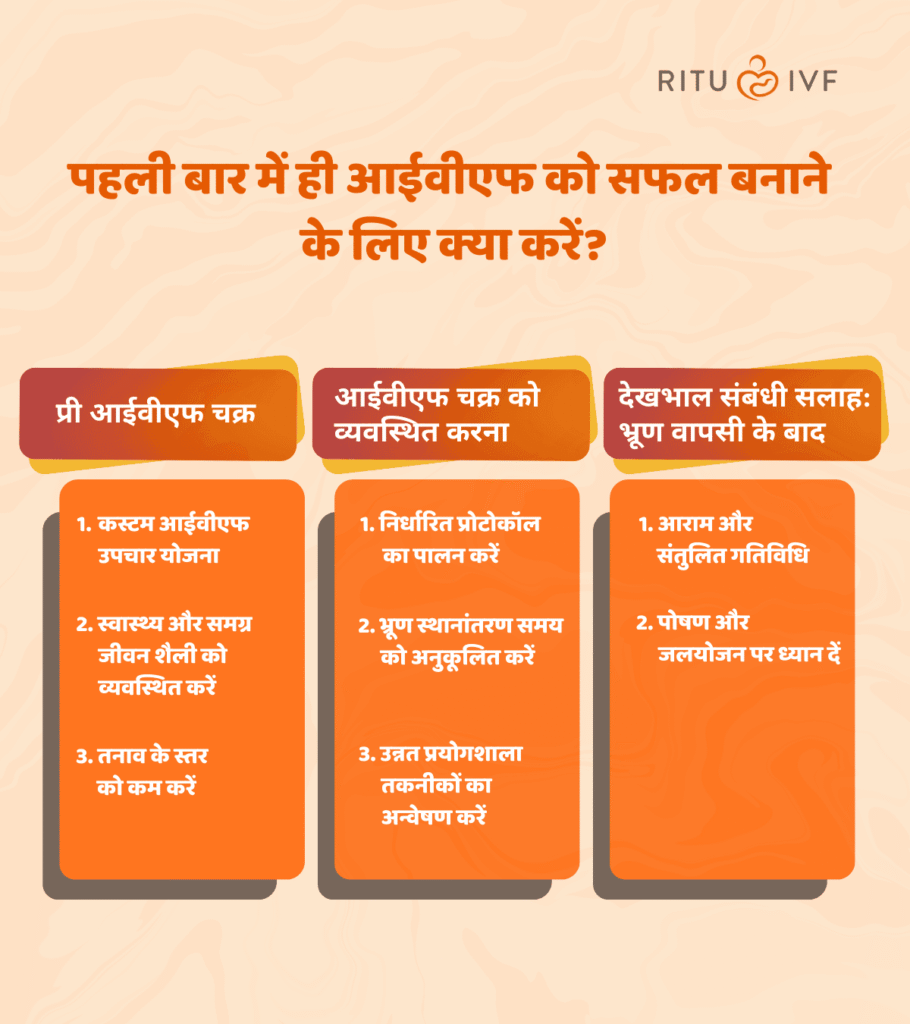
    प्रजनन के इच्छुक दम्पत्तियों और व्यक्तियों के लिए इन-विट्रो फर्टिलाइजेशन (IVF) एक जीवन बदलने वाली यात्रा है। यह प्रक्रिया शारीरिक, भावनात्मक और आर्थिक रूप से काफी जटिल है, इसलिए ज़्यादातर लोग पहले ही प्रयास में सफलता की संभावना बढ़ाना चाहते हैं। आज हम इसी विषय पर बात करने वाले हैं कि आईवीएफ को सफल कैसे बनाएँ और खासकर पहली बार में ही बेहतर परिणाम कैसे प्राप्त करें। यह सिर्फ़ एक चिकित्सीय प्रक्रिया से कहीं ज़्यादा है; इसमें उचित जीवनशैली में बदलाव, सही क्लिनिक का चयन, और शरीर और दिमाग की तैयारी भी शामिल है।

    इस ब्लॉग पोस्ट में, हम विस्तार से जानेंगे कि IVF की सफलता की संभावना किन बातों पर निर्भर करती है – जैसे आपकी उम्र, खानपान, मेडिकल हिस्ट्री, तनाव का स्तर, और आपके फर्टिलिटी डॉक्टर का अनुभव। तैयारी के लिए एक समग्र दृष्टिकोण अपनाकर, जिसमें भावनात्मक स्वास्थ्य, शारीरिक स्वास्थ्य और सोच-समझकर निर्णय लेना शामिल है, आप सफल प्रक्रिया की संभावनाओं को बहुत बढ़ा सकते हैं। एक सक्रिय दृष्टिकोण अपनाने से न सिर्फ़ पहले ही प्रयास में IVF के सफल होने की संभावना बढ़ जाती है, बल्कि समग्र IVF अनुभव भी बेहतर होता है। तो आइए, जानें कि आप अपनी IVF यात्रा को कैसे सफल बना सकते हैं।

    मुफ़्त परामर्श लें

    पहले प्रयास में IVF की सफलता दर का निर्धारण

    IVF की सफलता दर को समझना कई कारकों की वजह से जटिल हो सकता है, जिनमें उम्र, जीवनशैली, स्वास्थ्य और महत्त्वपूर्ण फर्टिलिटी फैक्टर शामिल हैं। औसतन, 35 साल से कम उम्र की महिलाओं में पहले प्रयास में IVF की सफलता दर 40 से 50% होती है, हालांकि बढ़ती उम्र के साथ सफलता की दर कम हो सकती है।

    30 के दशक के अंतिम पड़ाव से लेकर 40 के दशक की शुरुआत की महिलाओं के लिए, सफलता दर आम तौर पर 20 से 30% के बीच होती है और 42 साल की उम्र के बाद इसमें और भी गिरावट आती है। अंडों और शुक्राणुओं की गुणवत्ता, डॉक्टरी सलाह का पालन और गर्भाशय का स्वास्थ्य जैसे कारक पहली बार IVF करवाने वालों की तैयारी में महत्वपूर्ण भूमिका निभाते हैं।

    हालांकि, यह याद रखना ज़रूरी है कि पहला साइकिल हमेशा गर्भावस्था का कारण नहीं बन सकता। IVF एक चिकित्सीय प्रक्रिया है, और जब अतिरिक्त प्रयास किए जाते हैं, तो सफलता की संभावना बढ़ जाती है। IVF की सफलता के मुख्य तत्त्वों में स्वस्थ जीवन जीना, तनाव को नियंत्रित करना, डॉक्टर की सलाह का पालन करना और सही फर्टिलिटी क्लिनिक चुनना शामिल है।

    पहली बार में IVF कैसे सफल बनाएँ? जानें सबसे असरदार तरीके।

    पहली बार में ही आईवीएफ को सफल बनाने के लिए क्या करें

    आज कई दम्पत्तियों का सपना IVF के ज़रिए परिवार शुरू करने का होता है, लेकिन पहली बार में सफलता की संभावना को ज़्यादा से ज़्यादा करने के लिए सोच-समझकर निर्णय लेने और सावधानीपूर्वक योजना बनाने की ज़रूरत होती है। पहली बार में IVF की सफलता के लिए ये सुझाव स्वास्थ्य में सुधार, सही योजना बनाने, डॉक्टर की सलाह का पालन करने और सफलता की संभावना को बढ़ाने पर ध्यान केंद्रित करते हैं।

    A) IVF साइकिल से पहले

    1. कस्टमाइज़्ड IVF उपचार योजना

    हर दम्पत्ति की अपनी फर्टिलिटी यात्रा होती है, इसलिए एक व्यक्तिगत योजना का होना बहुत ज़रूरी है। पहला कदम अक्सर पूरी फर्टिलिटी जाँच होती है। महिलाओं के लिए, इसमें आम तौर पर ओवेरियन रिज़र्व की जाँच, अल्ट्रासाउंड और हार्मोन के स्तर का संयोजन शामिल होता है, जिससे डॉक्टरों को एक बेहतरीन उपचार योजना तैयार करने में मदद मिलती है। पुरुषों के लिए, वीर्य विश्लेषण (सीमेन एनालिसिस) से शुक्राणु की गुणवत्ता की पुष्टि होती है और किसी भी ऐसी असामान्यता की पहचान होती है, जिसे IVF उपचार से पहले ठीक करने की ज़रूरत हो सकती है।

    इस स्तर पर, किसी भी चिकित्सीय समस्या को ठीक करना बहुत ज़रूरी है। थायरॉयड असंतुलन, मधुमेह या विटामिन डी की कमी जैसी चिकित्सीय समस्याएँ, अगर इन्हें ठीक न किया जाए, तो सफलता की संभावना को नकारात्मक रूप से प्रभावित कर सकती हैं। संभावित समस्याओं को जल्दी पहचानकर और उन्हें ठीक करके, दम्पत्ति और व्यक्ति अपने IVF साइकिल के लिए एक मज़बूत नींव रख सकते हैं। हालाँकि, सही उम्मीदें रखना और हर चरण में क्या उम्मीद करनी है, इस बारे में जागरूक रहना आपको भावनात्मक रूप से तैयार होने और आपके समग्र अनुभव को बेहतर बनाने में मदद कर सकता है।

    1. स्वास्थ्य और समग्र जीवनशैली को बेहतर बनाना

    IVF साइकिल शुरू करने से पहले, स्वास्थ्य को प्राथमिकता देना ज़रूरी है। खान-पान और IVF की सफलता पर बहुत ज़ोर दें और लीन प्रोटीन, स्वस्थ वसा, साबुत अनाज, फल और सब्जियों से भरपूर संतुलित आहार लें, जो प्रजनन क्षमता को बढ़ाते हैं और आपके शरीर को उपचार के लिए तैयार करते हैं। प्रसंस्कृत भोजन, कैफीन और चीनी को कम करने से अंडे और शुक्राणु के विकास के लिए एक स्वस्थ वातावरण बन सकता है।

    खान-पान के अलावा, आप IVF की सफलता के लिए जीवनशैली में बदलाव करने पर भी विचार कर सकते हैं। जिन व्यक्तियों का वज़न कम या ज़्यादा है, उनमें हार्मोनल असंतुलन हो सकता है, जिससे प्रजनन क्षमता कम हो सकती है। एक स्वस्थ जीवनशैली में नियमित व्यायाम (पैदल चलना, योग या हल्का कार्डियो) भी शामिल है। IVF की सफलता में नींद का महत्त्व शरीर को हार्मोन और रक्त प्रवाह को नियंत्रित करने की अनुमति देने की क्षमता में निहित है। व्यायाम का एक स्वस्थ संतुलन बनाए रखने से (अत्यधिक गतिविधि के बिना) शरीर को ठीक से ओव्यूलेट करने और अपनी प्रजनन क्षमता को बनाए रखने में मदद मिलेगी।

    1. तनाव के स्तर को कम करें

    IVF की प्रक्रिया भावनात्मक रूप से थका देने वाली हो सकती है, और ज़्यादा तनाव का स्तर आपके हार्मोनल संतुलन और प्रजनन स्वास्थ्य पर प्रतिकूल प्रभाव डाल सकता है। IVF के दौरान तनाव को प्रबंधित करना, जैसे कि माइंडफुलनेस का अभ्यास करना, ध्यान या गहरी साँस लेने के व्यायाम से आपके दिमाग को शांत करने और IVF उपचार से गुज़रने के लिए तैयार करने में मदद मिल सकती है।

    अपने साथी के साथ संवाद करने और विशिष्ट उपचार से अतिरिक्त सहायता लेने के तरीकों को ढूँढना भी प्रोत्साहित किया जाएगा। तनाव को कम करने के लिए एक मज़बूत भावनात्मक सहायता प्रणाली स्थापित करना IVF प्रक्रिया को प्रबंधित करने और परिणामों को बेहतर बनाने के लिए ज़रूरी है। इसके अलावा, हमारी फर्टिलिटी यात्राओं के दौरान सकारात्मक दृष्टिकोण अपनाना फायदेमंद हो सकता है।

    B) IVF साइकिल को बेहतर बनाना

    1. निर्धारित प्रोटोकॉल का पालन करें

    सही रास्ते पर बने रहने के लिए फर्टिलिटी टीम द्वारा दिए गए दवा योजना और जीवनशैली की सिफ़ारिशों का पालन करना ज़रूरी है; एक डोज़ भूलना या चिकित्सीय सलाह का पालन न करना आपके IVF साइकिल को बदल देगा और आपकी सफलता की संभावना को कम कर देगा।

    इसके अलावा, मरीज़ों को अपने डॉक्टर के साथ नियमित रूप से संवाद बनाए रखना चाहिए, सवाल पूछने चाहिए और सभी निर्धारित अपॉइंटमेंट में जाना चाहिए। यह दृष्टिकोण आपको अपनी IVF के ज़रिए यात्रा का लाभ उठाने और उसे बेहतर बनाने में मदद करने के लिए समस्याओं को जल्दी पहचानने और ठीक करने में मदद करेगा।

    1. भ्रूण स्थानांतरण के समय को बेहतर बनाएँ

    अगर आप पहले ही प्रयास में सफल होना चाहते हैं, तो भ्रूण स्थानांतरण के समय को सही करना ज़रूरी है। डॉक्टर आम तौर पर आरोपण की संभावनाओं को बेहतर बनाने के लिए गर्भाशय की परत के विकास को भ्रूण की तैयारी से मेल खाने की सलाह देते हैं।

    एंडोमेट्रियल रिसेप्टिविटी एनालिसिस (ERA) जैसी विभिन्न विधियाँ यह सुनिश्चित कर सकती हैं कि ट्रायल एंड एरर को कम करने और IVF यात्रा को बेहतर बनाने के लिए स्थानांतरण इष्टतम आरोपण विंडो पर हो रहा है।

    1. आधुनिक लैब तकनीकों के बारे में जानें

    टाइम-लैप्स इमेजिंग, ब्लास्टोसिस्ट कल्चर, या ICSI (इंट्रासाइटोप्लाज्मिक स्पर्म इंजेक्शन) जैसी तकनीकें भ्रूण की गुणवत्ता को बढ़ा सकती हैं और पहले IVF साइकिल के सफल होने की संभावनाओं को बढ़ा सकती हैं।

    जटिल बांझपन की स्थिति वाले या असफल पिछले प्रयासों वाले दम्पत्ति अनजाने में होने वाली देरी से बचने और अपने पहले IVF साइकिल में भ्रूण आरोपण को बेहतर बनाने में मदद करने के लिए उपलब्ध तकनीकों वाली प्रयोगशाला की सराहना कर सकते हैं।

    C) देखभाल संबंधी सलाह: भ्रूण वापस करने के बाद

    1. आराम और संतुलित गतिविधि

    भ्रूण को वापस करने के बाद 24-48 घंटों के लिए आराम और राहत की सलाह दी जाती है, जिससे आपके उपचार के बाद अधिकतम रिकवरी समय मिल सके। आपको सख़्त बेड रेस्ट पर रहने की ज़रूरत नहीं है, लेकिन आरोपण के लिए एक सहायक वातावरण बनाने के लिए गतिविधि को कम करना या भारी गतिविधि के बिना हल्की गतिविधि करना मददगार होता है।

    धीरे-धीरे चलने और रोज़ाना के काम करने के लिए प्रोत्साहित किया जाता है, क्योंकि ये गतिविधियाँ रक्त संचार में मदद करती हैं और शरीर पर ज़्यादा दबाव नहीं डालती हैं। इसमें अपने शरीर की बात सुनना और एक आरामदेह दिनचर्या में रहना भी शामिल है, जो आपको इस स्तर के दौरान अनावश्यक दबाव को सीमित करने में मदद करेगा।

    1. पोषण और हाइड्रेशन पर ध्यान दें

    भ्रूण को स्थानांतरित करने के बाद, एक ऐसे आहार पर ध्यान केंद्रित करें जिसमें सब्ज़ियों, प्रोटीन, साबुत अनाज और ताज़े फलों से पोषक तत्व शामिल हों। ये सभी ऐसे भोजन हैं जो प्रजनन स्वास्थ्य का समर्थन करने के लिए जाने जाते हैं। ओमेगा-3, फोलेट और आयरन से भरपूर भोजन गर्भाशय की परत और आरोपण को मज़बूत करने में सहायता करते हैं।

    इसके अलावा, हाइड्रेशन भी उतना ही ज़रूरी है! शरीर के कामकाज के नियमन का समर्थन करने, IVF दवाओं से जुड़ी सूजन को कम करने और प्रजनन स्वास्थ्य का समर्थन करने वाली कोशिकाओं तक पोषक तत्व पहुँचाने के लिए पर्याप्त पानी पिएँ।

    यह भी पढ़ें – आईवीएफ प्रेगनेंसी में सफलता पाने के 10 ज़रूरी उपाय


    निष्कर्ष

    क्या आप सोच रहे हैं कि IVF को पहली बार में ही कैसे सफल बनाया जाए? IVF की सफलता दर चिकित्सीय सलाह, भावनात्मक तैयारी और जीवनशैली के अभ्यासों पर निर्भर करती है। अपने डॉक्टर की सलाह का पालन करके, तनाव को कम करके और एक स्वस्थ जीवनशैली बनाए रखकर, आप सकारात्मक परिणाम प्राप्त करने के लिए सबसे अच्छी संभव परिस्थितियाँ बनाते हैं।

    डॉक्टर से बात करें

    प्रायः पूछे जाने वाले प्रश्न (FAQs)

    1. पहले IVF प्रयास में उम्र कितनी ज़रूरी है?

    कम उम्र की महिलाओं (<35 वर्ष) में IVF के सफल होने की संभावना ज़्यादा होती है, क्योंकि उनके अंडे बेहतर गुणवत्ता वाले होते हैं।

    2. IVF की सफलता में सप्लीमेंट (पूरक) की क्या भूमिका है?

    फोलिक एसिड, विटामिन डी, और CoQ10 जैसे सप्लीमेंट IVF चक्र के दौरान शुक्राणु और अंडे दोनों के स्वास्थ्य के लिए फायदेमंद हो सकते हैं।

    3. क्या मुझे IVF के दौरान शराब और कैफीन से बचना चाहिए?

    हाँ, शराब और कैफीन का सेवन कम करने से आपके उपचार के परिणाम बेहतर होते हैं।

  • What to Do After Embryo Transfer to Increase Success?

    What to Do After Embryo Transfer to Increase Success?

    Congratulations, you have undergone IVF and reached one of the most exciting milestones: embryo transfer! This is a moment filled with anticipation, hope and a little nervousness. However, often amid the process, couples wonder – what to do after embryo transfer to increase success? Now that most of the process has passed from your hands to a qualified embryologist, there are some decisions you will need to make in the next few days that can help support the embryo in having the best opportunity to implant.

    Think of the next few days as nurturing a tiny seed you have planted with your body as the soil and the lifestyle habits as the care you are providing. Everything you do contributes to a healthy pregnancy, from the amount of rest you get and what you eat to how well you manage your stress. The journey doesn’t end with the embryo transfer; it really begins with the waiting period. One common anxiety for many couples is how to improve IVF implantation chances. There are ways to minimize anxiety, feel more in control, and increase the chances of a successful pregnancy. 

    Book a Consultation

    Key Symptoms to Expect During Post-Embryo Transfer

    A woman’s body will respond physically in several ways upon transfer as it prepares for implantation. The most important thing to remember is to remain positive and have faith in the process.  Practising patience, managing stress and prioritizing self-care are a few embryo transfer success tips. Let us understand the day-by-day symptoms to expect. 

    Day 1-3:

    • Mild cramping or bloating may occur
    • Light spotting due to catheter insertion.
    • You may feel fatigue as your body adjusts to hormonal changes. 

    Day 4-6:

    • The embryo may attach to the uterus, causing mild cramps. 
    • Individuals may suffer minor spotting, often known as implantation bleeding. 
    • You can experience an increased body temperature due to progesterone. 

    Day 7-10:

    • You can feel breast tenderness and sensitivity. 
    • Mood swings and mild nausea (like early pregnancy symptoms). 
    • Frequent urination may occur due to specific hormonal shifts. 

    Day 11-14:

    • Pregnancy symptoms can become noticeable in this stage. 
    • You may experience no symptoms at all, which is a natural occurrence. 
    • Conduct blood pregnancy test (Beta hCG) to confirm pregnancy on day 14.

    Read Also – 10 Best Foods to Increase Sperm Count Naturally in 2025

    What to Do After Embryo Transfer for Greater Success? Key Incorporation Tips

    The post-embryo stage is when the body requires a balance of rest, mindfulness, and nutrition to support implantation. Knowing that you are following the right post-embryo transfer care tips can help improve chances of success and keep you feeling positive during the waiting period.

    what to do after embryo transfer

    1. Maintain a Healthy Diet 

    Are you worried about what to do after embryo transfer to increase success? Include nutrient-rich foods in your diet to provide your body with the vitamins and minerals needed to support the balance and produce essential building blocks for hormone stability, maintain a healthy uterine lining, and support embryo development. 

    Foods to eat after embryo transfer include:

    • Eat foods that are substantial in protein, fibre, and healthy fats to nourish your body. It’s important to incorporate whole grains, nuts, leafy greens, avocados and seeds into your meals as frequently as possible.
    • Include folic acid (lentils, fortified cereals, and spinach), Vitamin D (exposure to sunlight, or supplements) to contribute to reproductive health.
    • Drink plenty of water, at least 8 to 10 glasses, to support circulation and the functioning of your body.

    2. Track Your Stress Levels

    Increased stress can disrupt hormonal balance, which is essential for implantation and early pregnancy. Minimizing stress makes sure your mind and body remain calm and receptive during this stage.

    Best practices after embryo transfer include:

    • Utilize types of relaxation techniques such as mindfulness meditation, prenatal yoga to deep breathing to allow your mind space to calm.
    • Reach out to your nearest and dearest for support or consider sourcing an online or in-person counsellor if you need additional support.
    • Incorporate light-hearted, enjoyable activities into your day like reading, light-hearted viewing and music.

    3. Follow Medication Guidelines Religiously

    After embryo transfer, your physician will probably prescribe medications such as progesterone inserts or hormone support. These medications are essential to support the uterine lining and assist implantation overall.

    Consider the following:

    • Take your prescribed medications as directed by your doctor. But do not skip doses, as it can affect the outcome.
    • Contact your physician immediately for side effects, including dizziness, nausea or allergic reaction.
    • Set alarms and reminders to ensure that you are taking medicines on time.

    4. Maintain a Healthy Routine

    Stick to a light routine, as it helps reduce stress, offers emotional stability, and supports a positive mindset during the waiting period after post-embryo transfer.

    Lifestyle changes post-embryo transfer to consider:

    • Concentrate on relaxation, but also engage your body. Mild stretching and light walking can help with blood circulation without applying stress to your body. 
    • Maintain a Consistent Sleep Schedule, as it is critical to hormone balancing and recovery.
    • Use Stress Relievers: Reading, meditation, and calming help you remain in a positive mindset.

    5. Know What to Expect Post-Embryo Transfer

    After an embryo transfer, the wait can feel like torture—but it is best for couples not to get too stressed and to remain as educated as possible.  While mild symptoms are usual, keep ca heck about unusual symptoms and ensure to report them immediately.

    What to monitor for:

    • Do NOT do early home pregnancy tests; there can also be misleading results
    • Stay positive and don’t let the stress of the waiting period get to you.
    • Follow the advice given by fertility specialists carefully.
    • Please advise your healthcare provider if you experience any unusual symptoms, excessive bleeding, fever, or excessive pain.

    6. Focus on Rest (But Don’t Overdo It)

    Resting after the embryo transfer process is vital but maintaining balance is just as important. You want to have light movement to promote blood flow and limit stress, but extensive bed rest is unlikely to help your cause.

    Embryo transfer recovery tips to follow:

    • Take it easy for the first 24 hours, getting plenty of rest.
    • Avoid prolonged bed rest beyond the initial recovery time.
    • Engage in gentle and short walks to keep your circulation active.
    • Listen to your body and stop if you feel any discomfort. 

    Read Also – How to Make IVF Successful the First Time: Expert Tips for Better Chances

    Whats app

    Things to Avoid After the Embryo Transfer Phase

    Small lifestyle choices can make a massive difference in post-embryo transfer success; hence, knowing what to avoid assists you in following a smooth post-transfer phase. 

    things to avoid after embryo transfer


    1. Excessive Caffeine and Alcohol

    Alcohol and caffeine can negatively affect implantation and early pregnancy development. High caffeine intake can reduce blood flow to the uterus, whereas alcohol can interfere with the hormone balance. Even moderate consumption can be discouraging during a sensitive timeframe. It is ideal to switch to decaffeinated beverages and avoid alcoholic drinks until your doctor advises it is safe. 

    2. Inessential Medications or Supplements

    A few medications and herbal remedies can interfere with implantation! Always consult your fertility specialist before taking medicines like cold remedies, painkillers or herbal supplements. Even harmless products can affect hormone levels or uterine lining receptivity. 

    3. Hot Baths, Saunas, or Jacuzzis

    Excessive heat can negatively affect embryo implantation. Hot baths, jacuzzis or saunas can raise your core body temperature, interfering with early embryo development. Hence, you should opt for lukewarm showers instead and avoid prolonged exposure to hot environments until your doctor confirms it is safe. 

    4. Practising Sexual Intercourse

    Light intimacy can be fine in a few cases; sexual intercourse immediately after embryo transfer is discouraged. Pelvic activity can cause uterine contractions, as it affects implantation. Follow your fertility clinic’s advice related to when it is safe to resume sexual activity. 

    5. Excessive Travel or Long Journeys

    Long car rides, flights or travel including heavy luggage must be avoided immediately after embryo transfer. Prolonged sitting can minimize blood flow to the pelvic area, and stress from travel can interfere with the implantation procedure. If travel is unavoidable, try to move and stretch regularly, stay hydrated and follow the doctor’s guidance. 

    Contact Us Now

    Conclusion

    Staying positive and maintaining a healthy lifestyle can significantly impact your IVF journey. By implementing key practices, you can support your body during this period. If you still have concerns about what to do after embryo transfer to increase success? Remember, the key is to balance rest, hydration, nutrition and stress management to give the embryo the best chance to implant and grow effectively. 

    FAQs

    1. What are the post embryo transfer do’s and don’ts?

    Avoid complete rest, heavy lifting, junk food habits, extreme stress and follow prescribed medicines, eating a balanced diet, stress management, and more. 

    2. Can I exercise after embryo transfer?

    Exercise recommendations after embryo transfer include light walking, deep breathing exercises, yoga, and more; however, avoid strenuous activities. 

    3. How soon will I notice any implantation sign?

    Some women may notice mild spotting or cramping – typical signs of successful embryo implantation, aren’t always present for everyone. However, if you face intense symptoms, then contact your doctor.