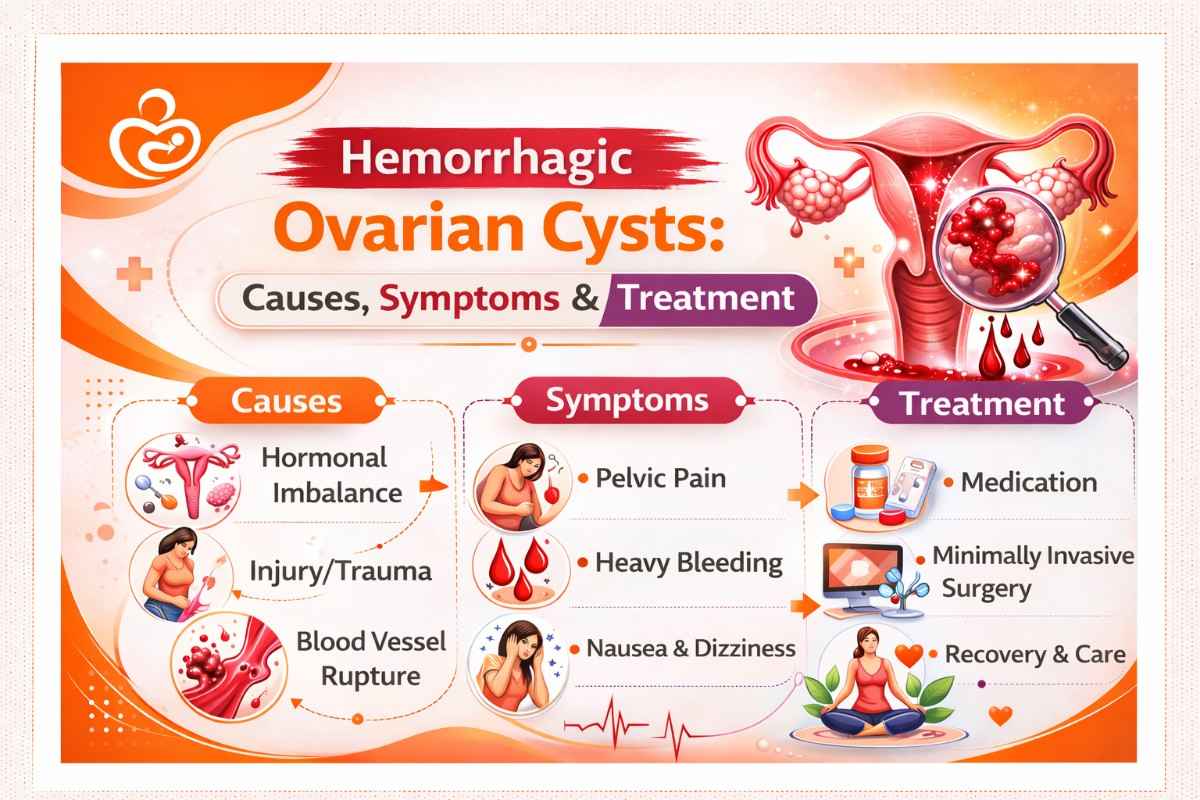
Many women in their reproductive years often have a hemorrhagic cyst, which is also called a blood cyst in the ovary or a hemorrhagic ovarian cyst. This medical condition develops when blood enters a functional ovarian cyst. Knowing about having a cyst might be scary, but most of the hemorrhagic cysts are not cancerous and resolve on their own without causing any long-term complications.
Many women discover they have a hemorrhagic ovarian cyst during a routine pelvic ultrasound or following the onset of pelvic symptoms. In a few cases, it might be associated with symptoms such as pain in the pelvis or the lower abdomen, heavy bleeding, or irregular menstrual cycles. So, women need to know what a hemorrhagic cyst is, what its symptoms and causes are, and what treatments are available so they may make good health decisions.

Ready to take the next step toward parenthoo
[Book an Appointment Now]
What Is a Hemorrhagic Cyst?
A hemorrhagic cyst is a kind of ovarian cyst that happens when blood leaks into a functional cyst. People often use the terms “hemorrhagic ovarian cyst” or “blood cyst in the ovary.” Most of the time, these cysts are not cancerous and are a normal component of the menstrual cycle.
During ovulation, a tiny sac called a follicle releases an egg. After the egg is released, the follicle may seal up and fill with fluid or blood. If blood collects in this sac, it becomes a hemorrhagic ovarian cyst.
Most hemorrhagic cysts go away on their own in a few weeks, even without therapy. But in other situations, they might create pain or problems that need medical treatment.
How does a hemorrhagic ovarian cyst form?
A hemorrhagic ovarian cyst usually comes from one of two functional cysts:
– Cyst of the follicle
– Cyst of the corpus luteum
After ovulation, the corpus luteum makes hormones that help the pregnancy. It normally gets smaller if you don’t get pregnant. But if bleeding happens inside this structure, it becomes a hemorrhagic cyst.
What Causes Bleeding?
You might bleed because of various reasons, such as
– Changes in hormones
– Blood vessels in the ovary that are weak
– Due to any trauma
– Problems with blood clotting
– Taking blood thinners
Is there a difference between a left ovarian hemorrhagic cyst?
A left ovarian hemorrhagic cyst is just a cyst that is in the left ovary. The anatomy and risk of a left-sided cyst are not fundamentally different from those of a right-sided cyst.
But discomfort from a left ovarian hemorrhagic cyst may be felt in the lower left side of the abdomen, which may look like problems with digestion or sometimes feel like kidney or intestinal pain. Ultrasound imaging is often used to confirm a diagnosis.
Signs and Symptoms of a Hemorrhagic Ovarian Cyst
A lot of females don’t have any symptoms. But when symptoms do happen, they could include:
Typical Symptoms
– Pain in the pelvis that comes on suddenly
– A dull ache in the lower abdomen
– Pain when you ovulate
– Having pain during sex
– Feeling bloated
– Periods that are not regular
Severe Symptoms (Signs of an Emergency)
– Having pain in the stomach that is sharp and strong
– Experiencing dizziness or fainting
– Feeling sick and throwing up
– Signs of internal bleeding
– Having a fast heartbeat
If a hemorrhagic cyst breaks, it might cause bleeding inside the body, which needs to be treated right away.
Causes and Risk Factors of Hemorrhagic Cysts
Women of childbearing age are most likely to get hemorrhagic cysts, and they are not as common after menopause.
Some factors that can make you more likely to get cysts are:
– Hormonal imbalance
– Irregular menstrual periods
– Endometriosis
– Polycystic ovarian syndrome (PCOS)
– Blood-thinning medications
– Treatments for fertility
– During pregnancy
Diagnosis of Hemorrhagic Ovarian Cyst
Doctors usually find out if someone has a hemorrhagic ovarian cyst by:
1. Examining the Pelvis
A doctor might examine the pelvis to sense pain or swelling.
2. An ultrasound scan
This is the test that is most often done, and it helps figure out:
- The size of the cyst
- If there is any internal bleeding present
- The blood flow
- Risk of any rupture
3. Blood tests
- Blood tests are done to check for ectopic pregnancy
- Check the levels of haemoglobin
- Check for any infections
Treatment for Hemorrhagic Cysts
There are a few critical things that affect how a hemorrhagic cyst is treated, such as how big the cyst is, how severe the symptoms are, the age of the patient, pregnancy status, any risk of rupture, findings from the ultrasound, and the general state of health.
Most hemorrhagic ovarian cysts are self-limiting and go away on their own without needing any invasive treatment. But treatment must always be tailored to the person.
The size, symptoms, and problems of a hemorrhagic cyst affect how it is treated.
1. Firstly, by wait and watch
Most hemorrhagic ovarian cysts reduce on their own in about 6 to 8 weeks.
Doctors might suggest conservative management, which includes regular follow-ups, performing an ultrasound regularly (6-8 weeks), and avoiding stressful physical activities.
2. Pain relief
For minor signs, NSAIDs, like ibuprofen, heating pads and taking rest are recommended.
For moderate or severe pain, stronger medications will be prescribed by the doctor.
3. Hormonal Treatment
Birth control medications might stop new cysts from forming and regulate the menstrual cycle by reducing hormonal fluctuations
4. Surgery
Surgery is needed if the cyst is big (>5 cm)
Pain that is very severe in nature
If the presence of any rupture leading to internal bleeding inside the body.
If any ovarian torsion occurs.
If there is a suspicion of malignancy.
Surgical choices include:
Laparotomy (in complicated cases)
Ovarian cyst removal with laparoscopic surgery (minimally invasive procedure)
Removal of the ovary is rare in young women, and doctors remove only the blood cyst present in the ovary
How to Prevent a Hemorrhagic Cyst
You cannot always prevent it from happening, but you can lower the risk by:
– Keeping hormones in balance
– Having regular gynaecological checkups
– Taking care of the PCOS condition
– If your doctor prescribes it, use hormonal birth control.
– By avoiding hormonal changes
When You Should See a Doctor
If you have any of the following, consult a doctor immediately.
– If there is severe pain in the stomach
– Persistent pelvic pain
– Fever
– A lot of heavy bleeding
– Feeling dizzy or passing out
– Pain that is getting worse with time
Having regular gynaecological examinations helps find cysts early.
Ready to take the next step toward parenthoo
[Book an Appointment Now]
Conclusion
A hemorrhagic cyst is also called a hemorrhagic ovarian cyst or a blood cyst in the ovary. Women of childbearing age often have this condition, which is usually not potentially dangerous. In many instances, these cysts go away on their own in a couple of months. However, having knowledge of the symptoms and causes, and understanding the treatment options for hemorrhagic cysts can help you get medical attention when required.
If anyone suspects they could be having a hemorrhagic cyst or experiencing any unusual symptoms, such as pelvic pain, or noticing any cysts or lumps in their menstrual blood, visit a gynaecologist for a full checkup. It is suggested to watch out for any warning signs and get frequent checkups to avoid any complications and maintain your reproductive health
Frequently Asked Questions
Q1. What is the treatment for a hemorrhagic cyst if detected during pregnancy?
If a cyst is found during pregnancy, your doctor will suggest waiting and watching unless there are any symptoms. Also, most of the cysts that happen during pregnancy resolve on their own. If surgery is required at all, the second trimester is the preferred time, as it is safest.
Q2. Is fertility affected due to the presence of a hemorrhagic cyst in females?
In many cases, fertility is not affected by a hemorrhagic cyst. However, having cysts that are recurrent in nature might cause hormonal imbalances and further impact the ovulation.
Q3. How is a blood cyst formed in the ovary?
When the small blood vessels present inside a functional cyst are ruptured, bleeding occurs, leading to a blood cyst in the ovary. Various factors contribute, such as any hormonal changes, menstrual changes, and medication.
Q4. What symptoms might one have when there is a haemorrhagic cyst?
There might not be any symptoms for a few people, and they might often get diagnosed during routine ultrasound scans or checkups. But symptoms such as sharp pain or any dull ache in the lower abdomen, or one-sided pelvic pain, might be experienced by a few, which shouldn’t be ignored.
Q5. Can a hemorrhagic cyst be formed due to stress?
Stress might not directly lead to a hemorrhagic cyst, but it will impact the hormonal levels, which indirectly affect the ovulation in females.
Leave a Reply